

Android 17 is approaching its final release, and the safest early upgrade bets are recent Google Pixel phones, Samsung flagships covered by long-term support, newer OnePlus models, selected Xiaomi flagships, recent Nothing phones and the latest premium devices from OPPO, vivo, Motorola and HONOR. But there is no single universal Android 17 compatibility list: every manufacturer follows its own policy, and eligibility can vary by model, market and carrier.
Google confirmed that Android 17 reached Platform Stability with Beta 3 in April 2026. That means the platform APIs are locked and manufacturers can complete compatibility work, but it does not
This PhonesGate guide separates devices into three groups: high-confidence candidates, policy-backed expected devices and models that still require confirmation. That distinction matters because a phone can be technically capable of running Android 17 without being covered by the manufacturer’s official upgrade commitment.
Key takeaway
A detailed Android 17 eligibility guide covering Google Pixel, Samsung Galaxy, OnePlus, Xiaomi, Nothing, OPPO, vivo, Motorola, HONOR and Sony phones.
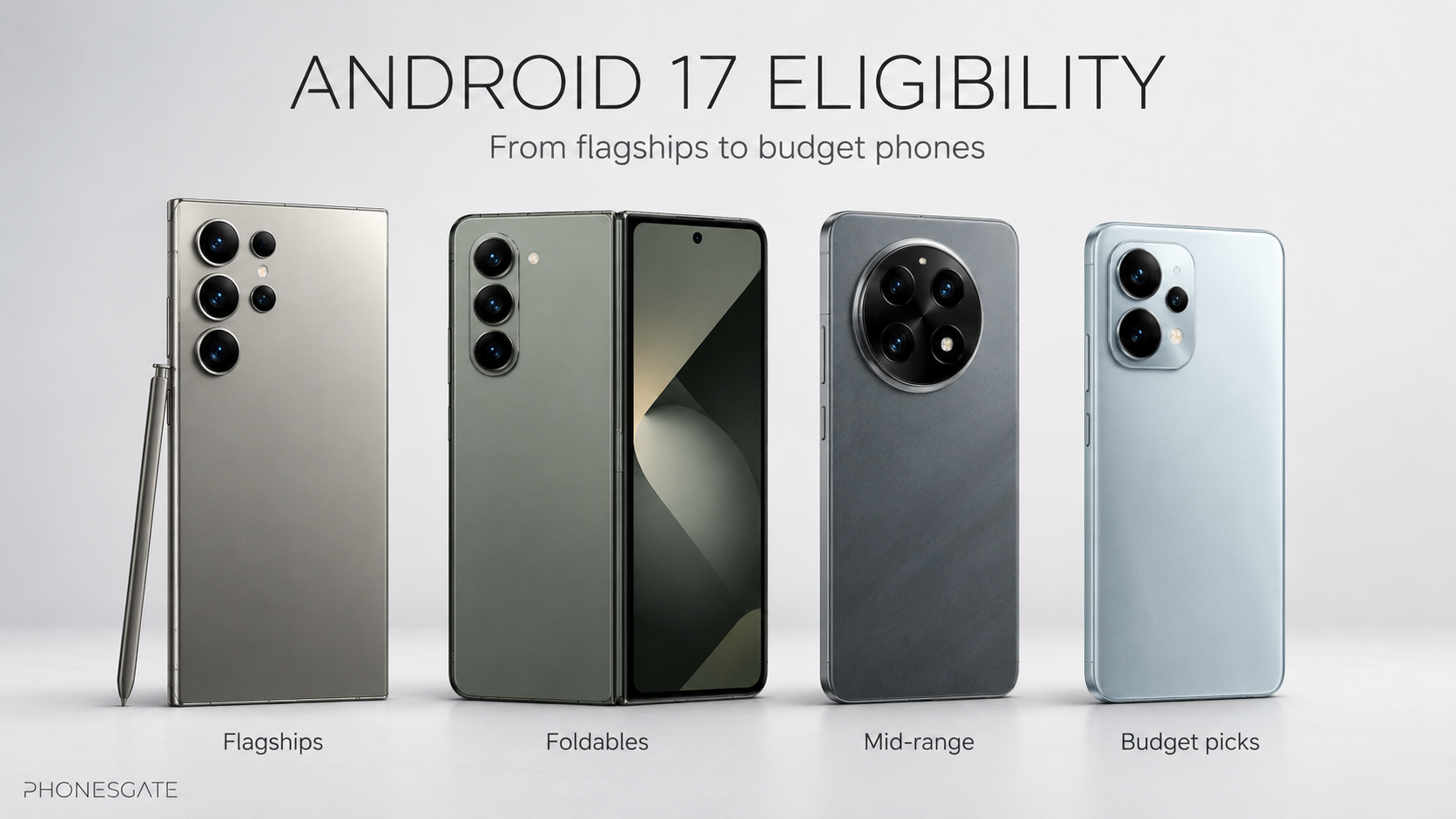
Quick answer: which phones are most likely to receive Android 17?
Brand Highest-confidence families Confidence Google Pixel 8 series and later; Pixel 6 and Pixel 7 families remain strong candidates within their support windows Very high Samsung Galaxy S23 and later, Z Fold5/Flip5 and later, recent A-series models covered by four, six or seven OS upgrades Very high OnePlus OnePlus 11 and later, OnePlus Open, Nord 4 and newer eligible Nord models High Xiaomi / Redmi / POCO Xiaomi 13T series, Xiaomi 14 and 15 families, selected newer Redmi and POCO devices Medium to high Nothing Phone (2a), Phone (2a) Plus, Phone (3a) series, Phone (3), Phone (4a) series High OPPO Recent Find X and Find N flagships, plus selected newer Reno models Medium to high vivo X300 series, including the X300 Pro Android 17 Beta device; newer X-series flagships High for X300, medium for older models Motorola Recent Edge and Razr models with multi-generation upgrade commitments Model-dependent HONOR Recent Magic flagship devices, especially EU models covered by seven-year support High for covered models Sony Newest Xperia flagships still inside their published support window Model-dependent
Methodology: how PhonesGate determines Android 17 eligibility
We did not simply list every recent Android phone. Each model family was evaluated using four signals:
13 min read
Samsung coverage from PhonesGate. Published Jul 27, 2026.
- Official Android 17 participation: a manufacturer beta programme or developer preview is the strongest early evidence.
- Official update policy: the number of promised Android generations determines whether Android 17 falls within the device’s support window.
- Launch Android version: a phone launched with Android 14 and promised three major upgrades should normally reach Android 17; a phone launched with Android 12 and promised four upgrades normally ends at Android 16.
- Region and carrier limitations: the same marketing name can have different chipsets, software schedules or support policies across markets.
The lists below use the following labels:
- High confidence: Android 17 falls clearly inside an official policy or the device is part of an Android 17 programme.
- Expected: the model should qualify based on its launch version and published support commitment, but the manufacturer has not issued a final Android 17 list.
- Needs confirmation: policies vary by market, exact variant or carrier.
Google Pixel phones expected to get Android 17
Google provides the clearest support policy in the Android ecosystem. Pixel 8 and later phones receive seven years of operating-system and security updates from their original US Google Store availability date. Pixel 6, Pixel 7 and the original Pixel Fold receive five years of updates.
Very high confidence
- Pixel 10
- Pixel 10 Pro
- Pixel 10 Pro XL
- Pixel 10 Pro Fold
- Pixel 10a
- Pixel 9
- Pixel 9 Pro
- Pixel 9 Pro XL
- Pixel 9 Pro Fold
- Pixel 9a
- Pixel 8
- Pixel 8 Pro
- Pixel 8a
Strong candidates within the five-year support window
- Pixel 7
- Pixel 7 Pro
- Pixel 7a
- Pixel 6
- Pixel 6 Pro
- Pixel 6a
- Pixel Fold
- Pixel Tablet
The Pixel 6 generation is the most time-sensitive group. It remains within Google’s published support period during the expected Android 17 release window, but users should still wait for Google’s final stable rollout list before treating support as guaranteed for every region and variant.
Samsung Galaxy phones expected to get Android 17
Samsung is likely to have the largest Android 17 device list. The Galaxy S24 generation introduced seven Android OS upgrades and seven years of security support, while several earlier flagships received four generations of operating-system updates. Newer Galaxy A models also receive extended support, although the exact number varies.
Galaxy S series
High confidence:
- Galaxy S26, S26+ and S26 Ultra
- Galaxy S25, S25+, S25 Ultra and supported S25 variants
- Galaxy S24, S24+, S24 Ultra and S24 FE
- Galaxy S23, S23+, S23 Ultra and S23 FE
The Galaxy S22 series is not expected to receive Android 17 under its original four-generation policy because it launched with Android 12 and its fourth major upgrade is Android 16.
Galaxy Z foldables
- Galaxy Z Fold8 Ultra
- Galaxy Z Fold8
- Galaxy Z Flip8
- Galaxy Z Fold7 and Z Flip7
- Galaxy Z Fold6 and Z Flip6
- Galaxy Z Fold5 and Z Flip5
The Z Fold4 and Z Flip4 launched with Android 12 and are expected to finish their major-version commitment with Android 16.
Galaxy A series
The following families are strong Android 17 candidates where their regional model is covered by Samsung’s published upgrade policy:
- Galaxy A56, A36 and A26
- Galaxy A55 and A35
- Galaxy A54 and A34
- Galaxy A16 5G and newer long-support A-series devices
Samsung’s A-series naming is broad, and support can vary between LTE and 5G variants. Buyers should check the exact model number, not only the product name.
Galaxy tablets
Recent Galaxy Tab S flagships covered by multi-generation support are expected to receive an Android 17-based One UI update, including newer Tab S9 and Tab S10 families and their supported successors.
OnePlus phones expected to get Android 17
OnePlus officially expanded support on selected flagships to four generations of OxygenOS and five years of security updates. Newer devices may receive longer security maintenance, but the major-version count remains the key Android 17 signal.
High-confidence OnePlus models
- OnePlus 15 and supported OnePlus 15 variants
- OnePlus 13 and OnePlus 13R
- OnePlus 12 and OnePlus 12R
- OnePlus 11
- OnePlus Open and its supported successor models
- OnePlus Nord 4
- OnePlus Nord CE5
- Newer Nord devices launched with Android 15 or Android 16 and covered by multi-version support
The OnePlus 11 is particularly important because Android 17 should be the final major update under its four-generation policy. Older OnePlus 10-series devices are generally outside the Android 17 window.
Xiaomi, Redmi and POCO phones expected to get Android 17
Xiaomi is more complicated because support differs significantly between flagship Xiaomi models, T-series phones, Redmi devices and POCO variants. Xiaomi maintains a model-specific product-support database, so the safest approach is to verify the exact device rather than assuming that every phone from the same year receives the same update.
High-confidence or policy-backed Xiaomi models
- Xiaomi 15, 15 Pro, 15 Ultra and newer flagship models
- Xiaomi 14, 14 Pro, 14 Ultra and 14T-series models covered by extended support
- Xiaomi 13T and 13T Pro, which were announced with four Android OS upgrades
Selected Redmi and POCO candidates
- Recent Redmi Note 14 and newer eligible variants
- Selected Redmi K-series models launched with Android 14 or later
- POCO F6-series and newer models where Android 17 falls within the published upgrade count
- Recent POCO X and M models only where the exact support page confirms eligibility
Do not assume the entire Redmi Note 13 range is eligible. Some variants launched on different Android versions and received different promises. The same caution applies to POCO models sold under different regional names.
Nothing phones expected to get Android 17
Nothing’s policy is easier to calculate because the company publishes the number of major Android updates on individual product pages.
Expected to receive Android 17
- Nothing Phone (4a) and Phone (4a) Pro
- Nothing Phone (3)
- Nothing Phone (3a) and Phone (3a) Pro
- Nothing Phone (2a)
- Nothing Phone (2a) Plus
Phone (2a) and Phone (2a) Plus launched with Android 14 and are promised three major Android upgrades, which places Android 17 inside their support window.
Not expected
- Nothing Phone (2), whose three-upgrade cycle is expected to end with Android 16
- Nothing Phone (1)
- CMF Phone 1, if its original two-generation Android commitment remains unchanged
OPPO phones expected to get Android 17
OPPO’s recent Find flagships receive long security support, but major Android-version commitments must still be checked by model. The following are the strongest candidates:
- OPPO Find X9, X9 Pro and X9 Ultra
- OPPO Find X8 and Find X8 Pro
- Recent Find N foldables, including Find N5/N6-generation devices where sold
- Selected Reno 13, Reno 14 and newer models covered by sufficient OS upgrades
Reno support varies heavily by region. Two phones with similar names may have different chipsets and different update commitments, so the final ColorOS 17 list should be treated as the source of truth.
vivo and iQOO phones expected to get Android 17
vivo is already running an Android 17 Beta programme for the X300 Pro, making that device one of the clearest non-Pixel candidates.
Highest confidence
- vivo X300 Pro
- vivo X300
- vivo X300 Ultra
- Newer X-series models launched after the X300 family
Expected, but verify by region
- vivo X200 and X200 Pro
- Selected X100-series models still inside their regional support commitment
- Recent vivo V-series flagships
- Recent iQOO numbered flagships and Neo models with multi-generation support
vivo publishes security-update lists, but major Android commitments are not always identical across markets. The global, Indian and Chinese software tracks can also differ.
Motorola phones expected to get Android 17
Motorola provides a model-by-model upgrade schedule rather than one universal promise across the entire brand. Android 17 eligibility should therefore be checked through Motorola’s software-upgrade portal.
Strong candidates
- Motorola Edge 60 Pro and supported Edge 60 variants
- Motorola Razr 60 Ultra and recent Razr foldables
- Recent Edge 50 models with three or more promised Android upgrades
- Newer ThinkPhone models covered by enterprise-focused support
Budget Moto G devices are less predictable. Some receive only one or two major upgrades, so release year alone is not enough to establish Android 17 support.
HONOR phones expected to get Android 17
HONOR announced seven years of Android OS and security updates for its flagship Magic series in EU markets, starting with covered devices introduced under that programme.
High-confidence EU flagship candidates
- HONOR Magic7 Pro
- Newer HONOR Magic8-series devices
- Recent Magic V foldables covered by the same regional commitment
Other candidates
- HONOR 400-series and newer models where Android 17 is listed inside the product-specific support window
- Selected HONOR 200 models, depending on the exact global support listing
HONOR’s seven-year commitment is region-specific. A model purchased outside the EU may have a different policy.
Sony Xperia phones expected to get Android 17
Sony publishes current Android versions and software-release information for individual Xperia products, but its support policy is narrower and more model-specific than Google or Samsung.
The strongest candidates are the newest Xperia 1 and Xperia 10 generations that launched on Android 14, Android 15 or Android 16 with Android 17 inside their promised upgrade window. Xperia 1 VI and newer flagships should be checked against Sony’s official model page before publication or purchase.
Phones that are unlikely to receive Android 17
These older families are generally outside their original major-version commitments:
- Google Pixel 5a and older Pixel phones
- Samsung Galaxy S22 series and older
- Samsung Galaxy Z Fold4 / Z Flip4 and older
- OnePlus 10 series and older
- Nothing Phone (1) and Phone (2)
- Many Xiaomi 12-series, older Redmi and older POCO devices
- Older OPPO Reno, vivo V/Y and Motorola Moto G models with short policies
A phone can continue receiving security patches after it stops receiving major Android upgrades. “No Android 17” does not automatically mean the device is immediately unsafe or unusable.
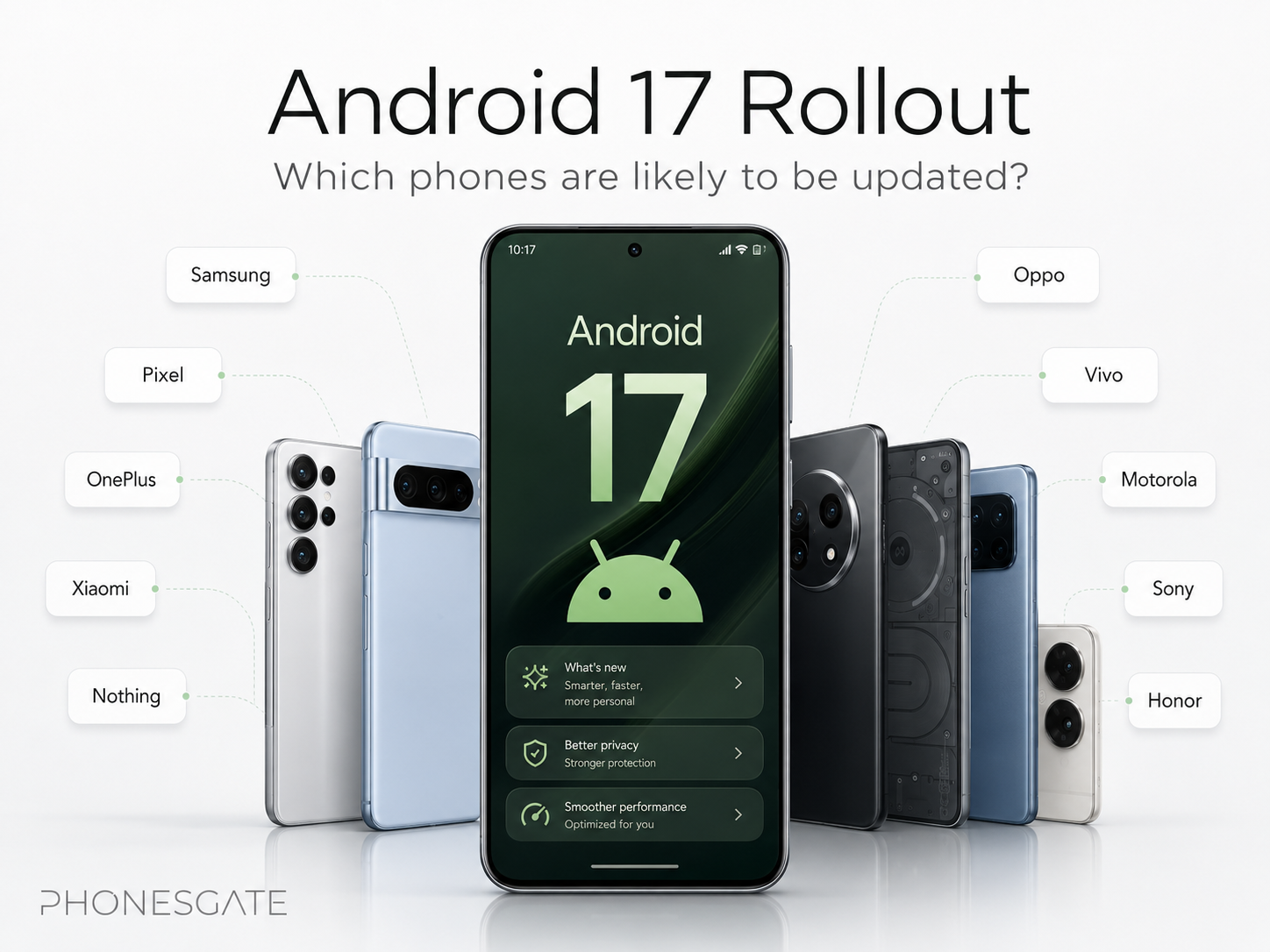
When will Android 17 arrive?
Android 17 reached Platform Stability in April 2026, which is one of the final development milestones before general availability. Google’s stable Pixel release should arrive first, followed by manufacturer testing and staged rollouts.
A realistic rollout order is:
- Google Pixel: stable Android 17 release and the earliest monthly fixes.
- Samsung flagships: Android 17 through a new One UI version after beta testing.
- OnePlus, Xiaomi, OPPO and vivo flagships: early regional betas followed by staged stable releases.
- Mid-range phones: later waves after flagship validation.
- Carrier models: additional certification can delay updates by weeks or months.
Manufacturers rarely update every eligible device on the same day. A phone appearing on an eligibility list only confirms that it should receive Android 17—not when the download will become available.
Why an eligible phone may not receive every Android 17 feature
Major Android support does not guarantee feature parity. Some functions depend on:
- On-device AI hardware and available RAM
- Camera sensors or secure hardware
- Manufacturer software, such as One UI, OxygenOS or HyperOS
- Language and country availability
- Carrier approval
- Google Play Services and app updates
A Pixel 10 and Pixel 8 may both receive Android 17 but not every new AI capability. The same applies to a Galaxy S26 Ultra and an older Galaxy A-series phone.
Should you install Android 17 immediately?
Most users should wait for the stable release rather than installing a developer or beta build on their primary phone. Beta software can contain battery drain, banking-app incompatibility, camera bugs and connectivity problems.
Install early only if:
- You understand how to restore the device
- Your essential apps are not mission-critical
- You have a current backup
- The manufacturer officially supports the beta on your exact model
Before the stable update
- Back up photos, messages and authentication data
- Keep at least 10GB of storage free
- Update important banking and work apps
- Charge the phone above 50%
- Read the manufacturer’s known-issues list
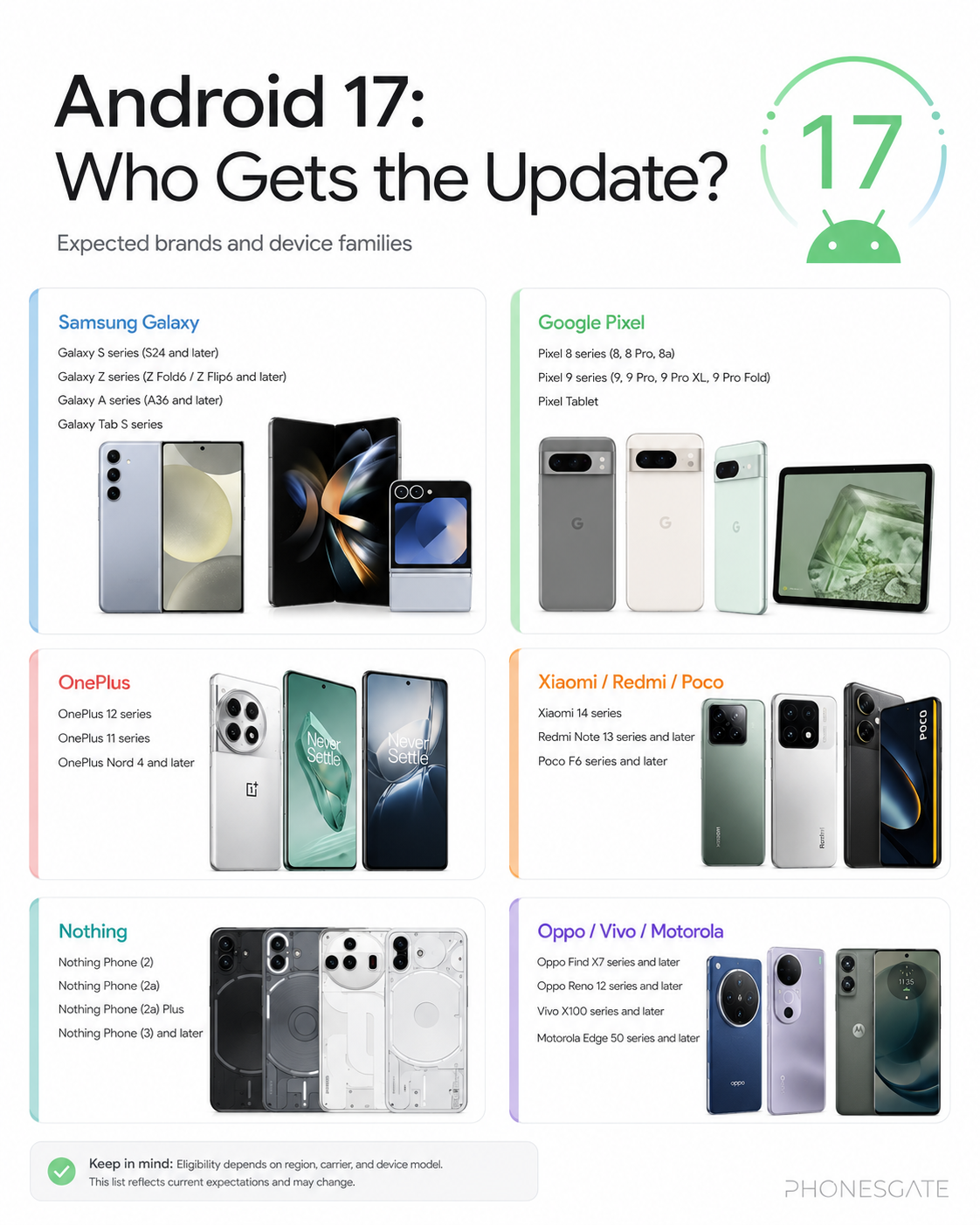
PhonesGate take: update policy is now a buying specification
The Android 17 cycle shows why software support should be treated like battery capacity or camera hardware. Two phones can launch at the same price and perform similarly, yet one may receive Android versions for twice as long.
Google, Samsung and HONOR have raised expectations with seven-year commitments on selected models. OnePlus, Nothing, Xiaomi and other brands have also extended support on important devices, but their policies remain more fragmented. Buyers should no longer accept vague claims such as “regular updates” without checking the number of major Android upgrades and the security-support end date.
The strongest long-term purchases are not necessarily the newest phones. A discounted Galaxy S24 Ultra, Pixel 9 Pro or Xiaomi 14-series flagship can remain an excellent buy when Android 17 and several later versions are already covered by policy.
Final verdict
Pixel 8 and later phones, Samsung Galaxy S23 and later flagships, Fold5/Flip5 and newer foldables, OnePlus 11 and later, Xiaomi 13T and newer supported flagships, recent Nothing phones and the latest premium models from OPPO, vivo, Motorola and HONOR form the core Android 17 eligibility group.
The final list will still change. Some mid-range phones will be added, some regional variants will be excluded and rollout dates will differ. The safest buying rule is simple: check the exact model’s official support policy and count major Android upgrades from the version installed at launch.
Frequently asked questions
Is Android 17 officially released?
Android 17 reached Platform Stability with Beta 3 in April 2026. Platform Stability locks the APIs, but the general stable rollout is a later milestone.
Will the Pixel 6 get Android 17?
The Pixel 6 family remains inside Google’s five-year update window during the expected Android 17 release period, making it a strong candidate. Final stable eligibility should still be confirmed by Google.
Will the Galaxy S22 get Android 17?
It is not expected to. The Galaxy S22 launched with Android 12 and its four promised major Android upgrades normally end with Android 16.
Will the Galaxy S23 get Android 17?
Yes, it is a high-confidence candidate. It launched with Android 13 and was promised four major Android OS upgrades.
Will the Nothing Phone (2) get Android 17?
It is not expected under its original three-major-update policy. The Phone (2) launched with Android 13, making Android 16 its expected final major version.
Does Android 17 eligibility guarantee every feature?
No. AI, camera, security and interface features may require newer hardware or may be limited by manufacturer, region or language.
Why does my eligible phone not have the update yet?
Android updates are staged by manufacturer, region and carrier. Eligibility does not mean immediate availability.