

August 12 is coming. Hold your breath — the Google Pixel 11 is almost here. Google has officially started the countdown to its next Made by Google event, where the new Pixel generation will take the stage in New York City. The Google Store now confirms the Pixel 11 name, the August 12 event date and the start of pre-orders on the same day.
This changes the story around the Pixel 11 series. We are no longer dealing only with CAD renders, supply-chain claims and scattered specification leaks. Google itself is now showing the hardware. Official teaser videos have revealed the Pixel 11 Pro’s refined camera bar and the new multicolour light element around the rear camera area, while another teaser confirms that the Pixel 11 Pro Fold will return with a familiar book-style design and a revised camera module.
Update — August 6, 2026: the August 12 launch and same-day pre-orders are official. Details involving Tensor G6, camera sensors, batteries, charging speeds, storage and prices remain preliminary until Google confirms the final specifications during the event.
Key takeaway
August 12 is coming and the Google Pixel 11 is almost here. Google has confirmed the launch date and same-day pre-orders, while the latest teaser campaign previews the Pixel 11 Pro and Pixel 11 Pro Fold.
Image note: the visuals in this article are original PhonesGate illustrations inspired by Google’s teaser campaign, created to present the story in a clean editorial format.
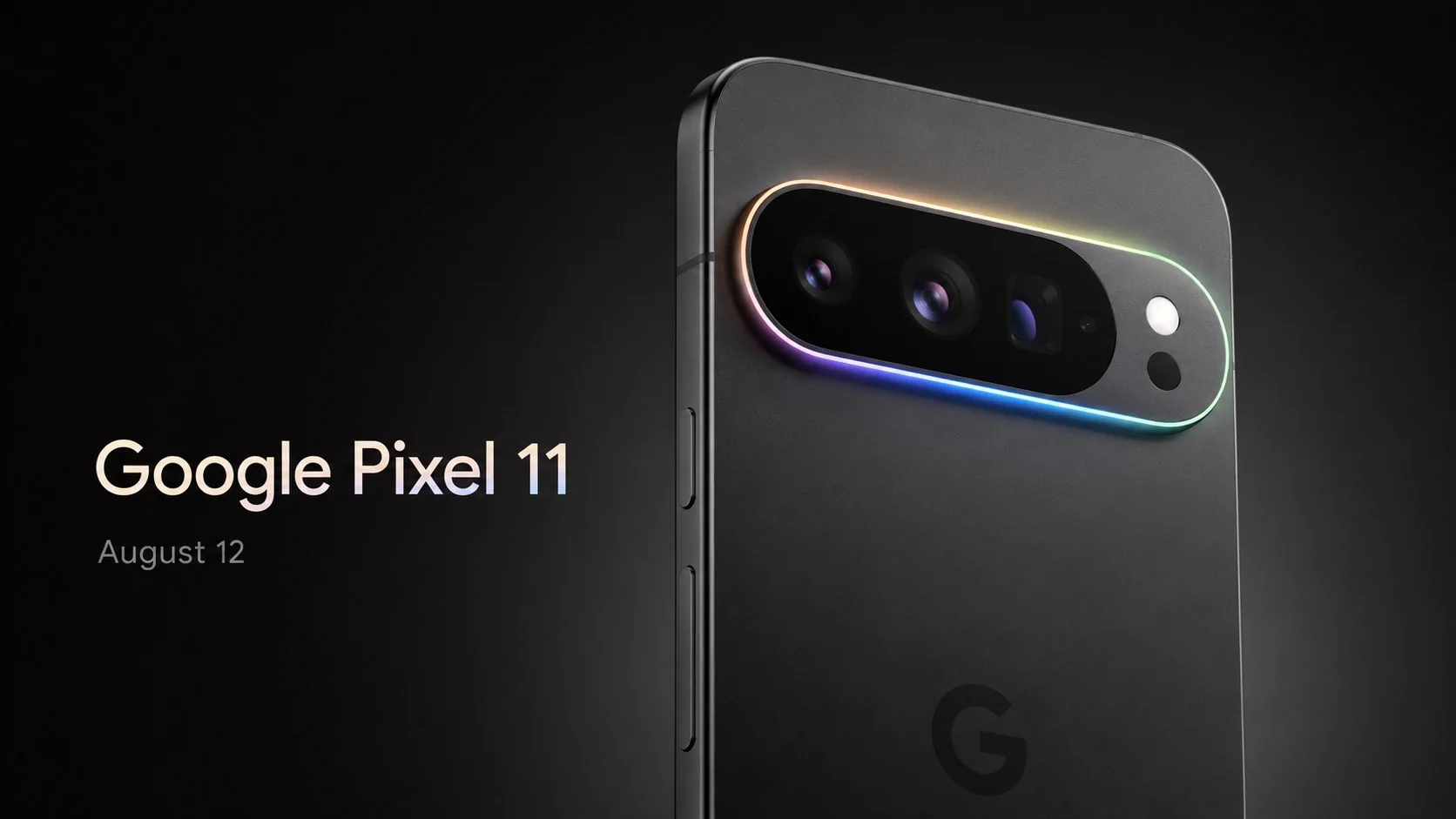
Google confirms August 12 for the Pixel 11 launch
The Google Store event page is direct: “The next generation. Google Pixel 11. August 12.” It also states that pre-orders will begin on August 12. That gives the Pixel 11 series a firm place in the 2026 flagship calendar and removes the uncertainty surrounding the previous August release window.
10 min read
Google coverage from PhonesGATE. Published Aug 6, 2026.
The event will be streamed from New York City. Google is expected to use the presentation not only to introduce new phones, but also to explain how its hardware fits into a broader Gemini-powered ecosystem. That is important because the official marketing is already focusing less on benchmark numbers and more on the idea that a Pixel should make Google’s services feel more connected and useful.
For buyers, the practical takeaway is simple: do not make a rushed Pixel purchase before August 12 unless an existing model is available at a genuinely strong discount. The official launch is close enough that confirmed specifications, regional availability, trade-in offers and pre-order incentives will soon replace speculation.
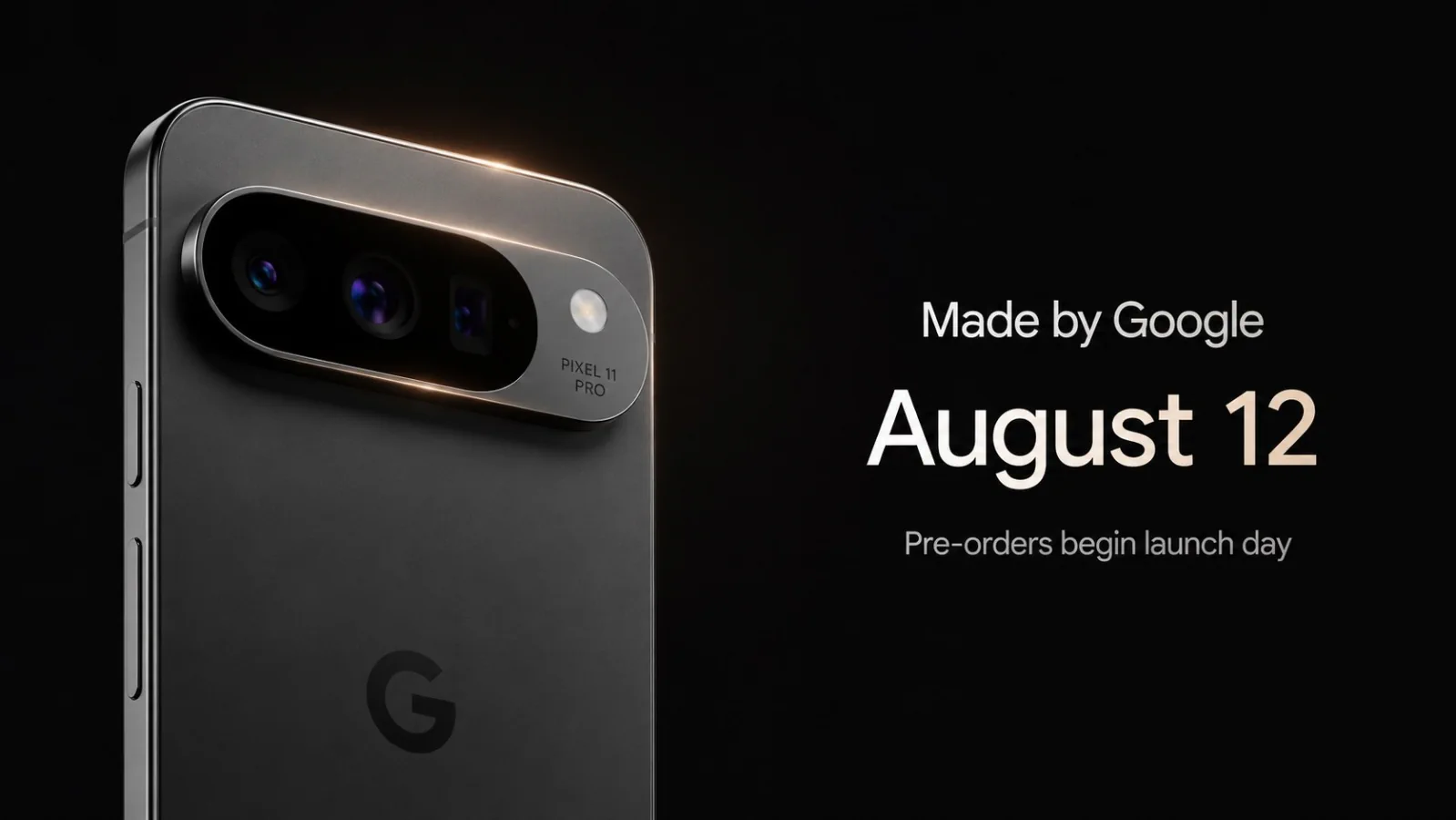
The Pixel 11 Pro teaser points to a more deliberate camera identity
Google’s Pixel 11 Pro teaser keeps the horizontal camera bar that has defined recent Pixel phones, but the presentation is more polished and more integrated. The phone is shown with a strong visual emphasis on the rear camera area, which now appears to play a bigger role in the product’s identity.
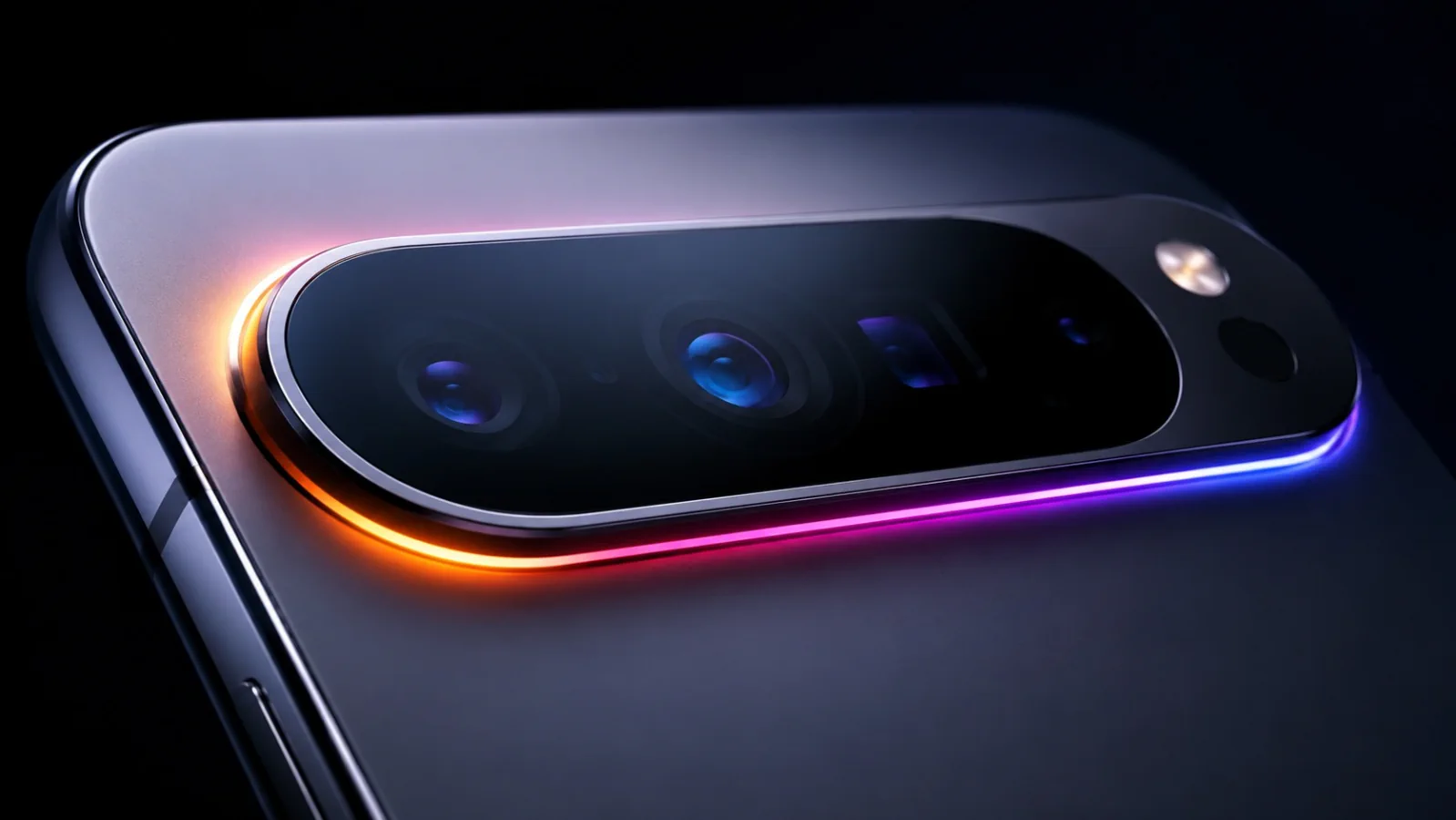
The most visible new element is the multicolour light near the camera bar. Early references called it Pixel Glow, while later reports suggest Google may market the feature as HiLight. Google has not yet fully explained what it does, so its final name and functionality should remain provisional until the launch event.
The teaser suggests that the light could be used as a visual status indicator for selected interactions, contacts or AI-driven functions. The exact implementation matters. A useful indicator could provide information without requiring users to turn on the display, but a purely decorative effect would add less practical value.
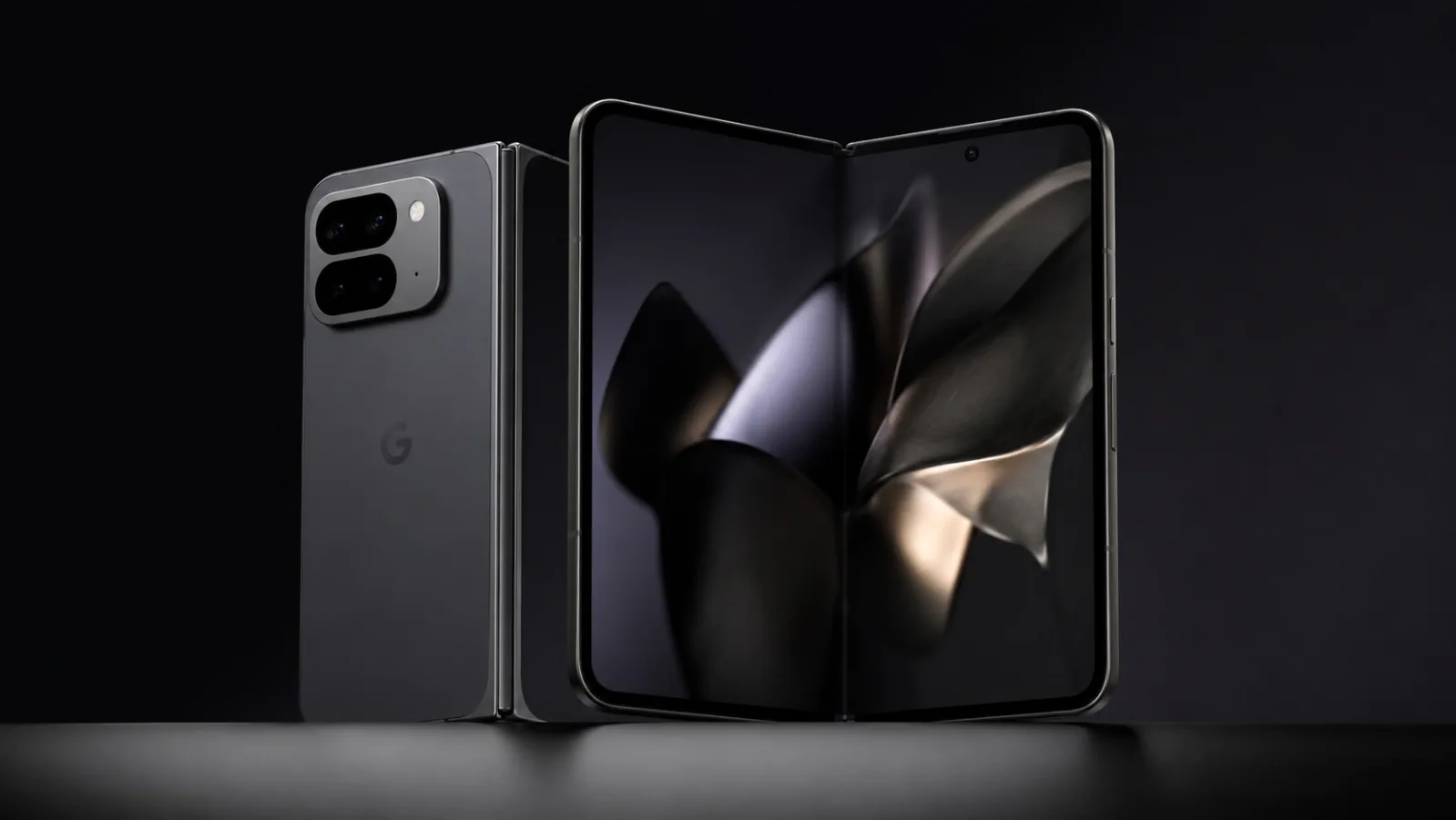
Pixel 11 Pro Fold is now part of Google’s teaser campaign
Google has also published an official teaser for the Pixel 11 Pro Fold. The short video confirms the return of a book-style foldable and gives a close look at the device’s hinge, frame and rear camera area.
The foldable appears to retain the general approach established by previous Pixel Fold generations, but the camera module is more clearly divided into pill-shaped sections. Google’s messaging — “open to what’s new” and “what opens” — makes it clear that the Fold is being positioned as a central part of the Pixel 11 family rather than a side experiment.
That is strategically important. The 2026 foldable market is much more competitive, with Samsung, HONOR, vivo, OPPO and other brands pushing thinner bodies, larger batteries and stronger cameras. Google does not need only a familiar Pixel software experience; it also needs hardware that is easier to carry and more competitive as a camera phone.
Expected Pixel 11 lineup
Google has officially confirmed the Pixel 11 generation, while current reporting points toward a four-device family:
- Google Pixel 11 — the standard flagship and likely entry point to the new generation.
- Google Pixel 11 Pro — a smaller premium model with the full Pro camera strategy.
- Google Pixel 11 Pro XL — the large conventional flagship with the biggest display and battery in the non-folding range.
- Google Pixel 11 Pro Fold — the book-style foldable now shown in Google’s official teaser campaign.
The final model names, storage configurations and regional availability should still be checked on launch day. Google sometimes varies its product selection between markets, and the Fold in particular may have a narrower rollout than the conventional phones.
Tensor G6: efficiency is still the upgrade that matters most
The Pixel 11 series is widely expected to introduce Tensor G6. Google has not yet published the final architecture or performance claims, so details involving manufacturing process, core configuration and modem supplier remain unconfirmed.
For real users, Tensor G6 does not need to win every benchmark. It needs to solve the recurring weaknesses that have affected some earlier Pixel generations: heat under sustained load, high battery use on mobile data, inconsistent gaming performance and less efficient standby behaviour.
A successful Tensor G6 should deliver:
- lower temperatures during camera use, navigation and 5G;
- stronger sustained performance instead of short benchmark bursts;
- better battery efficiency during normal mixed use;
- faster on-device Gemini and photo-processing tasks;
- more dependable connectivity and modem behaviour.
If Google achieves those goals, the Pixel 11 could feel like a much bigger upgrade than a familiar exterior design suggests.
Cameras: Google needs better video and more consistent zoom
Photography remains one of the Pixel family’s strongest reasons to exist. Google’s computational processing continues to produce dependable exposure, skin tones, motion handling and night photography, but the competition has moved quickly.
The Pixel 11 Pro models are expected to receive the most meaningful camera changes. Current reports point to revised telephoto hardware and updated processing, but the precise sensor list is still unofficial. The redesigned camera area visible in teaser material confirms a visual change, not a specific sensor or zoom improvement.
PhonesGate’s priorities are straightforward: faster capture, cleaner moving subjects, stronger intermediate zoom, better low-light video and more consistent colour between the main, ultrawide and telephoto cameras. Google does not need the highest megapixel count. It needs the most reliable result when the user presses the shutter.
Battery and charging: optimization will decide the result
Battery capacities and charging speeds remain among the least certain parts of the pre-launch picture. Some reports suggest faster wired charging on selected models, but Google has not confirmed the final numbers.
Peak wattage alone will not determine whether charging is competitive. The charging curve, temperature management and the time required to reach useful levels such as 50% or 80% matter more in everyday life.
The larger opportunity is efficiency. A better Tensor platform, more efficient modem and refined displays could improve battery life without requiring dramatically larger cells. That would be particularly important for the Pixel 11 Pro Fold, where weight and internal space make battery design more difficult.
Gemini will be central, but usefulness matters more than the label
Google’s event invitation references Gemini Intelligence, and the Pixel 11 marketing campaign highlights services including Gemini, Gmail, Maps, Search, Calendar, Docs and Photos. The strategy is clear: Google wants the phone to feel like the natural hardware layer for its software ecosystem.
That can be a major advantage only when the features save time reliably. The strongest possibilities include call assistance, transcription, contextual search, photo organization, travel planning, cross-app actions and private on-device processing.
Google should also explain which functions run locally, which require cloud processing, what data is used and how users can disable features they do not want. AI becomes more valuable when it is accurate, transparent and under the user’s control.
Expected pricing and storage
Google has not confirmed Pixel 11 pricing. Reports suggest that some models may become more expensive, potentially because of higher component and memory costs. These figures should not be treated as final until Google publishes regional store listings.
Storage may be just as important as the headline price. A premium phone launching with 128GB becomes harder to justify as high-resolution video, offline media, large applications and on-device AI models consume more space. A 256GB base tier on the Pro models would improve long-term value even if launch prices rise.
Should you wait for the Pixel 11?
Wait if you are considering a Pixel 10 at full price. August 12 is too close to ignore. The launch will clarify pricing, storage, trade-in deals and whether Tensor G6 delivers the efficiency improvements many Pixel users want.
A discounted Pixel 10 may still be the smarter value. If retailers cut prices heavily after the Pixel 11 announcement, the older model could remain a strong purchase for users who do not need the new design details or latest AI features.
Pixel 8 and older owners have the strongest upgrade case. They stand to gain from several generations of camera, display, processor and battery refinements. Pixel 10 owners should wait for independent testing before assuming the new model justifies another upgrade.
PhonesGate take
Google does not need the Pixel 11 to reinvent the smartphone. It needs to improve the parts of the Pixel experience that users notice after the launch excitement is gone: heat, battery behaviour, connectivity, video quality, charging and long-term reliability.
The official teasers already show that Google is confident in the design. The camera bar remains recognizably Pixel, the new illuminated element gives the Pro models a visible identity, and the Fold is being promoted as a core part of the lineup.
The decisive answers will arrive on August 12. Until then, the launch date, Pixel 11 branding, same-day pre-orders and teaser designs are official. Tensor G6 details, final cameras, battery capacities, charging speeds, prices and availability should still be treated as preliminary.
Frequently asked questions
When will Google launch the Pixel 11 series?
Google has confirmed that the next Made by Google event will take place on August 12, 2026.
When do Pixel 11 pre-orders begin?
The Google Store says Pixel 11 pre-orders begin on August 12.
Has Google shown the Pixel 11 design?
Yes. Google has released official teaser videos showing the Pixel 11 Pro’s rear camera area and the Pixel 11 Pro Fold’s foldable design.
Is Tensor G6 officially confirmed?
Google has not yet published the final Tensor G6 specifications. It remains widely expected but should be treated as preliminary until the launch presentation.
Will the Pixel 11 Pro Fold launch with the other models?
Google is officially teasing the Pixel 11 Pro Fold ahead of the August 12 event, but final regional availability and shipping dates will be confirmed during or after the launch.