

The Galaxy S26 FE is one of those phones that looks easy to understand until you compare the details. Samsung gives it the Galaxy S name, a large AMOLED display, optical telephoto camera, wireless charging, IP68 protection, long software support and Galaxy AI features. Then it quietly trims the areas that cost more: memory, chipset headroom, display sophistication and some camera hardware.
Quick Read
The Galaxy S26 FE starts at $699.99 in the U.S. and keeps many of Samsung’s flagship essentials: a 6.7-inch 120 Hz AMOLED display, 50 MP main camera, dedicated 3x telephoto, large 4,900 mAh battery, wireless charging, IP68 and long software support. The biggest compromises are performance, memory, telephoto resolution and display sophistication compared with the regular Galaxy S26.
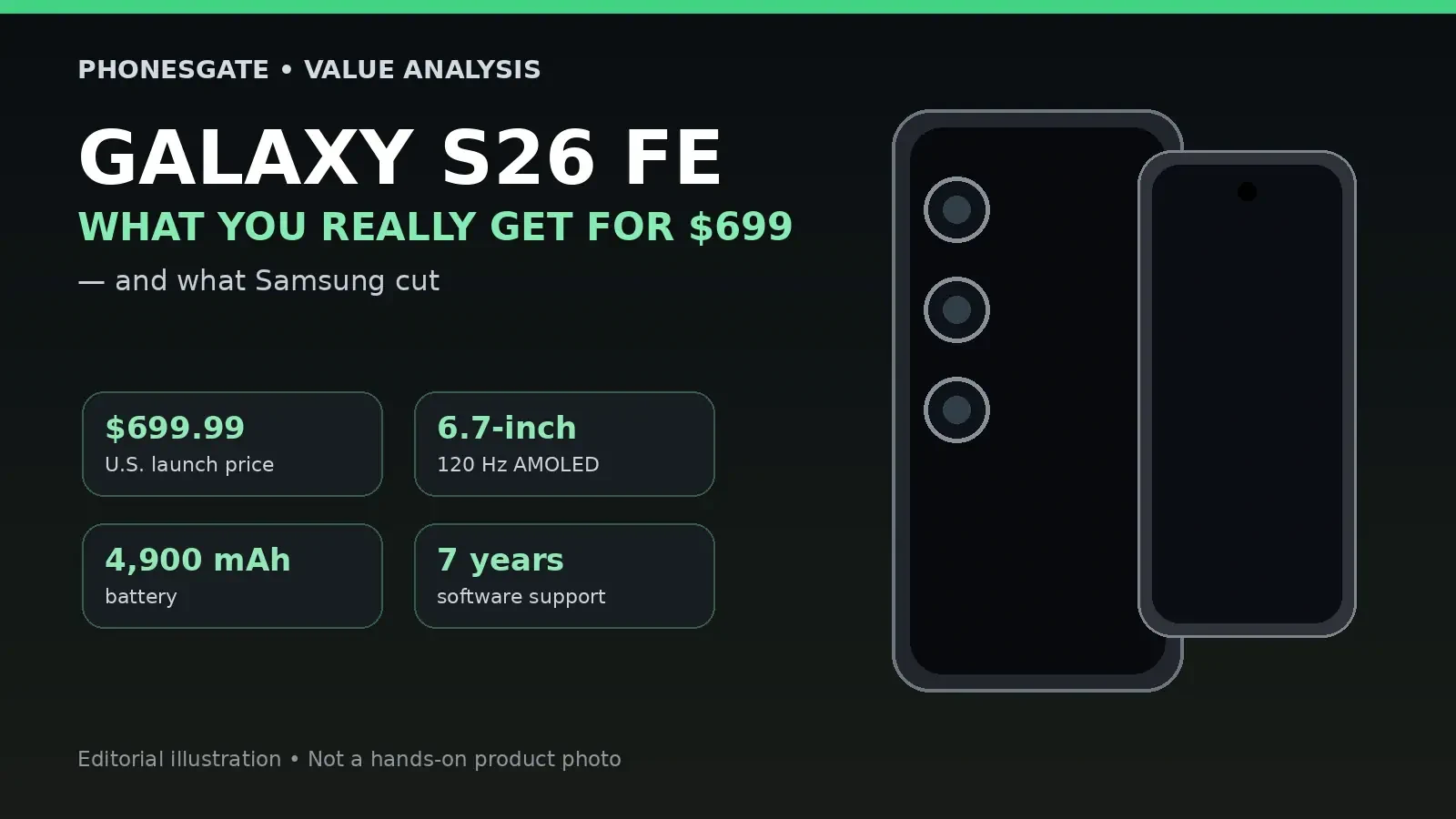
This article is intentionally a value analysis, not a hands-on review. PhonesGate has not physically tested the Galaxy S26 FE for this piece. Battery endurance, thermal behavior, camera consistency and long-term performance therefore remain things that need independent real-world testing rather than assumptions from a specification sheet.
Key takeaway
The Galaxy S26 FE keeps a large 120 Hz AMOLED display, 50 MP main camera, real 3x telephoto, 4,900 mAh battery, wireless charging, IP68 and long Samsung support. The trade-offs are 8 GB RAM, lower performance headroom, a simpler display system and an 8 MP telephoto. Its value depends heavily on how far below the regular Galaxy S26 it is priced.
One-Minute Read
The Galaxy S26 FE is not simply a cheaper Galaxy S26. It is larger and heavier, but also offers a bigger battery and more screen area. Samsung saves money with 8 GB RAM, Exynos 2500, an 8 MP telephoto and a less advanced refresh-rate system. The regular S26 offers 12 GB RAM, stronger flagship silicon, a 10 MP telephoto and a brighter adaptive display. The FE makes the most sense near its $699 entry price; once higher-storage variants approach Galaxy S26 pricing, the flagship becomes easier to justify.
First: why this article is different from our existing Galaxy S26 coverage
PhonesGate already covers the Galaxy S26 family through device pages and broader Samsung news. This article has a different search intent: it focuses specifically on the Galaxy S26 FE buying decision — what the lower price buys you, which flagship features remain, which areas Samsung cut, and when the standard Galaxy S26 becomes the smarter purchase.
9 min read
Samsung coverage from PhonesGate. Published Sep 14, 2026.

What Samsung kept for the $699.99 starting price
The most important thing about the S26 FE is that it does not feel like a stripped-down Galaxy A-series phone on paper. Samsung keeps many of the features that define the Galaxy S experience.
The phone uses a 6.7-inch Dynamic AMOLED 2X display with up to 120 Hz refresh. It includes a 50 MP main camera with optical image stabilization, a 12 MP ultra-wide camera and an 8 MP telephoto camera with 3x optical zoom. It also retains wireless charging, Wireless PowerShare, IP68 protection and Samsung’s modern software stack.
The battery is another major selling point. Samsung lists a 4,900 mAh battery, which is larger than the battery in the compact Galaxy S26. For people who care about screen size and endurance more than compact dimensions, the FE can actually look more practical than the standard flagship.
The dedicated 3x telephoto matters more than the camera count
A lot of phones around this price advertise triple cameras but use a weak secondary sensor or digital zoom. Samsung gives the S26 FE a real 3x optical telephoto, which immediately makes the camera system more useful for portraits, travel and framing subjects from a distance.

The compromise is resolution: the FE uses an 8 MP telephoto, while the regular Galaxy S26 uses a 10 MP 3x camera. That does not automatically tell us how large the real-world gap is — processing, optics and lighting matter — but it is a concrete hardware difference rather than marketing language.
The 50 MP main camera remains the core of the system, while the 12 MP ultra-wide covers landscapes and group scenes. Samsung is also leaning heavily on computational features and AI-assisted editing rather than presenting the FE as a revolutionary camera upgrade.
The 6.7-inch AMOLED is big, smooth and deliberately less sophisticated
For many users, the S26 FE display may be the phone’s strongest day-to-day feature. At 6.7 inches, it offers more physical screen area than the standard Galaxy S26. The 120 Hz refresh rate keeps scrolling and animations smooth, and Samsung’s AMOLED panels are usually a major part of the Galaxy experience.
But this is also one of the places where the cost cutting becomes visible on paper. The regular Galaxy S26 uses a more advanced adaptive refresh system and has a higher listed peak brightness. The FE still gives you a premium-looking panel specification, but not Samsung’s best display technology.
Samsung saved money on RAM and processing headroom
The Galaxy S26 FE uses the Exynos 2500 and 8 GB of RAM. That is enough for ordinary Android use, messaging, social media, streaming and mainstream photography, but it leaves less headroom than the regular Galaxy S26 with 12 GB RAM and stronger flagship silicon.
The difference matters most for people who keep phones for several years. Samsung’s long update policy is valuable, but the longer you keep a phone, the more useful extra memory and performance headroom become as apps, AI features and system software grow more demanding.
This is the central trade-off of the FE philosophy: Samsung gives you the flagship software ecosystem for longer, while the hardware underneath it is more carefully budgeted.
The FE is larger — and that is not automatically a disadvantage

The regular Galaxy S26 is the compact option. The S26 FE is the larger phone. That means the FE weighs more and takes up more space, but it also has room for a bigger display and bigger battery.
For buyers who watch a lot of video, browse heavily, read documents or simply prefer a larger phone, this can be a genuine advantage rather than a compromise. The FE should not be thought of as “the cheaper S26” in every dimension. It is better understood as a different balance of priorities.
The pricing problem starts when you move above the base model
The $699.99 headline price is where the Galaxy S26 FE makes the strongest case. The gap to the regular S26 is large enough that the hardware cuts feel logical.
The calculation changes when you compare storage tiers. If a higher-storage FE moves close to the price of the equivalent Galaxy S26, suddenly 12 GB RAM, better display technology, stronger silicon and the more premium camera configuration become easier to justify.
That makes one buying rule very simple: compare the exact storage configuration, not just the headline starting price.
Galaxy S26 FE vs Galaxy S26: the important differences
Area Galaxy S26 FE Galaxy S26 Positioning Lower-cost Galaxy S experience Main flagship Display size 6.7-inch 6.3-inch Refresh behavior Up to 120 Hz More advanced adaptive LTPO RAM 8 GB 12 GB Main camera 50 MP OIS 50 MP OIS Telephoto 8 MP, 3x optical 10 MP, 3x optical Battery 4,900 mAh 4,300 mAh Best reason to buy Large screen + battery + lower price Stronger all-round flagship hardware
Where the Galaxy S26 FE offers real value
The FE works best when the buyer prioritizes the things Samsung did not cut heavily: screen size, battery capacity, optical zoom, software features, wireless charging, IP protection and long-term support.
That combination is important because many mid-range phones force buyers to give up one or more flagship conveniences. The FE model exists to keep those conveniences while accepting a lower performance ceiling.
Where paying more for the Galaxy S26 makes sense
The regular Galaxy S26 is the better fit if you care about sustained performance, more RAM, a brighter and more adaptive display, a lighter compact body or simply keeping maximum hardware headroom over many years.
It also becomes increasingly attractive whenever promotions reduce the real-world price gap. Samsung phones frequently receive trade-in offers and temporary discounts, so launch MSRP should not be the only number you compare.
Who should buy the Galaxy S26 FE?
The S26 FE is a strong fit for users upgrading from an older Galaxy A, older FE or several-generations-old Galaxy S model. Those buyers can gain a large 120 Hz AMOLED, optical telephoto, modern Galaxy AI tools, wireless charging and long support without jumping directly to the full flagship price.
It is also a sensible choice for people who explicitly prefer a larger phone and value battery capacity over compact size.
Who should skip it?
If you already own a recent flagship, the FE is unlikely to feel like an upgrade. Performance-heavy users, serious mobile gamers and people who keep dozens of demanding apps active should also look carefully at the 8 GB RAM limitation.
And if the FE configuration you want sits only a small amount below the equivalent Galaxy S26, we would move up to the flagship rather than saving a relatively small amount.
PhonesGate verdict
The Galaxy S26 FE makes sense when the discount is the feature.
Samsung kept enough of the Galaxy S formula to make the phone attractive: a large AMOLED display, real optical telephoto, big battery, IP68, wireless charging, Galaxy AI and long software support. The cuts are targeted at areas that enthusiasts notice more than mainstream buyers: RAM, chipset headroom, display sophistication and some camera hardware.
At around $699, that trade-off is easy to understand. At a price much closer to the Galaxy S26, it becomes harder to defend.
That is why the smartest way to buy the S26 FE is not to ask whether it is “good.” It is to ask how much cheaper it is than the Galaxy S26 on the day you buy it.
For full Galaxy S26 specifications, see the PhonesGate Galaxy S26 device page. You can also browse the full PhonesGate device database.
Sources and methodology
Editorial disclosure: PhonesGate did not physically test the Galaxy S26 FE for this article. Official Samsung specifications and launch material are separated from PhonesGate’s editorial interpretation. Product photography embedded in the article is sourced from Samsung’s official image servers.