

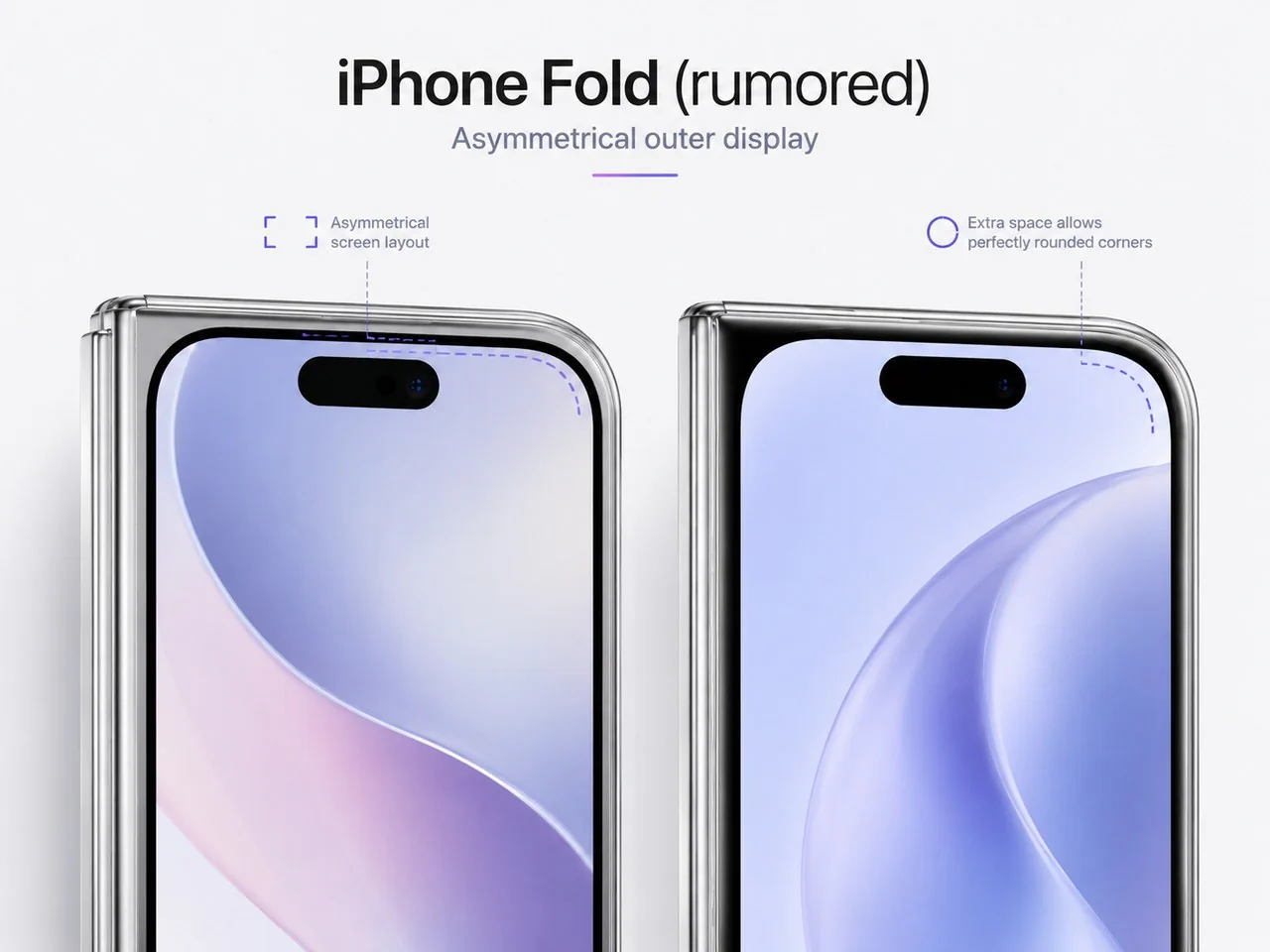
A new iPhone Fold concept is raising an unusual design question: would Apple deliberately leave part of the outer front surface unused to create perfectly rounded display corners? The image circulating on social media shows a book-style foldable with an asymmetrical front layout. One side of the outer screen appears to leave extra room near the hinge, while the exposed corner is rounded more aggressively than on a normal smartphone.
That exact design has not been confirmed by Apple, and we could not find an established supply-chain report independently verifying the asymmetrical outer-screen claim. For now, it should be treated as a concept based on a rumor rather than a reliable preview of the final hardware. Still, the idea is technically interesting because it addresses a real foldable-phone challenge: creating a front display that feels visually balanced while also accommodating the hinge, display driver components, cameras and structural protection.
More broadly, current reporting continues to point toward a book-style foldable iPhone with a smaller outer screen and an iPad-like internal display. That wider rumor picture makes this concept worth examining, even if the asymmetrical detail itself remains unverified.
Key takeaway
A new concept claims Apple may use an asymmetrical outer display on the iPhone Fold to achieve perfectly rounded corners. We separate that unverified claim from the broader, better-established foldable iPhone rumors.
What the new asymmetrical-front rumor claims
The circulating claim is simple: Apple may leave a small amount of unused space on one side of the iPhone Fold’s outer front surface so the visible display can use more uniform, deeply rounded corners. Instead of forcing the cover screen to fill every available millimeter, the design would prioritize shape and visual symmetry around the exposed edges.
At first, that sounds contradictory. How can an asymmetrical layout improve symmetry? The answer is that a foldable does not have equal structural conditions on both sides. One edge sits beside a complex hinge assembly, while the opposite edge behaves more like the outer corner of a normal phone. A designer may choose to offset the active display area slightly so the visible corners can match each other more closely, even if the screen is not perfectly centered within the full front panel.
9 min read
Apple coverage from PhonesGate. Published Aug 5, 2026.
There is also a practical possibility: the unused region could provide space for display electronics, antenna routing, structural reinforcement or camera hardware. That does not mean Apple will use this solution, but it explains why the concept is not completely random from an engineering perspective.
Why perfectly rounded corners could matter to Apple
Apple usually treats hardware shape, software masks and display geometry as one integrated system. On a conventional iPhone, the physical corner radius, the OLED panel and the interface are designed to align visually. A foldable complicates that relationship because the hinge side introduces extra thickness and different mechanical stresses.
If Apple cannot make all four outer-display corners look identical while filling the entire front panel, it may prefer a controlled margin rather than accepting visibly mismatched curvature. The company has previously chosen visual consistency over maximum numerical screen area, so a slightly smaller but cleaner cover display would fit that broader design philosophy.
The trade-off would be obvious: users would lose a small amount of usable screen space. Whether that matters would depend on how much space is actually sacrificed and whether Apple can make the remaining border look deliberate rather than accidental.
The broader iPhone Fold design picture
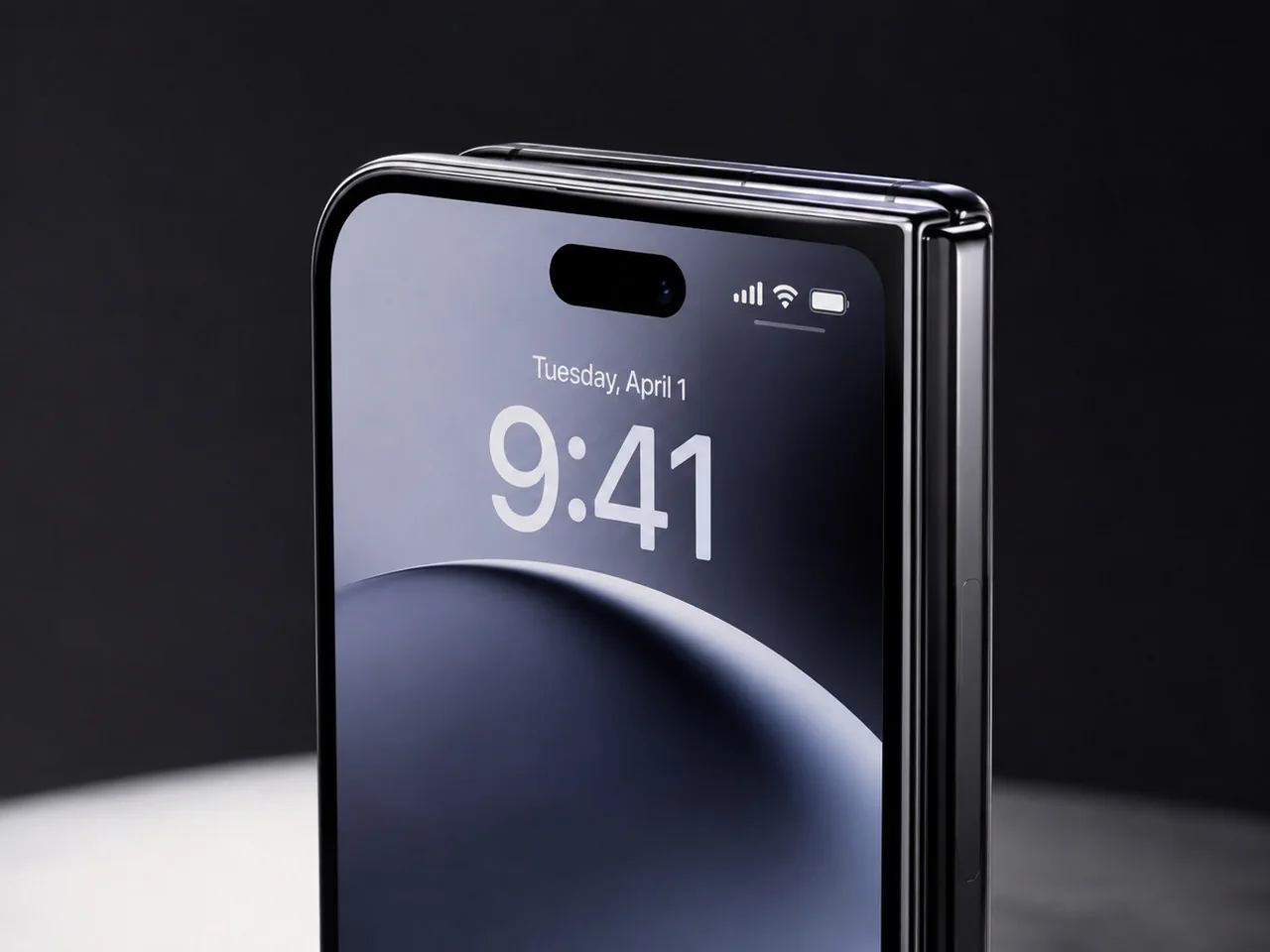
While the asymmetrical-front detail is not yet backed by established reporting, several broader iPhone Fold rumors have become more consistent. The device is widely expected to use a book-style design rather than a compact clamshell format. When closed, it would work like a small smartphone; when opened, it would provide a tablet-like canvas.
Current rumor roundups point to an outer display of roughly 5.5 inches and an internal display of around 7.8 inches. The inner panel is expected to use a squarer, approximately 4:3 aspect ratio, which would make the unfolded device better suited to reading, multitasking, documents and media than a tall phone-shaped canvas.
The device is also rumored to be exceptionally thin for a foldable, at roughly 4.5 to 4.8mm when open and around 9 to 9.5mm when closed. Those measurements remain unofficial, but they illustrate Apple’s likely priority: the first foldable iPhone cannot feel like two full-size phones stacked together.
Crease control may be more important than perfect symmetry
The most persistent iPhone Fold reports are not about the cover-screen shape. They are about the inner-display crease. Apple is said to have spent years trying to reduce or nearly eliminate the visible fold line that remains noticeable on many existing foldables.
Rumors suggest Apple could use ultra-thin glass, a custom display process and a more advanced hinge structure to flatten the inner panel more evenly. Liquid-metal components have also been mentioned for the hinge because the material can resist deformation and repeated stress better than some conventional alloys.
If Apple succeeds here, it could be the feature that makes the first foldable iPhone feel meaningfully different. Buyers are likely to forgive a slightly unconventional outer screen more easily than a distracting crease across the main internal display.
Touch ID, cameras and internal space
Internal space is one reason the asymmetrical-front concept is at least plausible. Foldables require room for two batteries, hinge components, display controllers and cameras across two thin halves. Every millimeter matters.
One widely repeated rumor says Apple may use Touch ID in the side button instead of Face ID. That would reduce the need for a complex front-facing sensor array and help keep the device thin. Current reports also point to an outer hole-punch camera, a possible under-display camera on the inside and two rear cameras rather than the three-lens system used by current Pro Max models.
None of those choices has been confirmed. But together they show how Apple may prioritize packaging efficiency over simply copying the current iPhone Pro design and adding a hinge.

Expected battery, performance and price
The iPhone Fold is expected to sit at the very top of Apple’s lineup. Rumors have mentioned 12GB of RAM, Apple’s next-generation mobile platform and a high-density battery that could fall somewhere between 5,400mAh and 5,800mAh. A larger battery would be necessary because the device must power both a cover screen and a much larger folding OLED panel.
Price could be the biggest barrier. Analyst estimates and reporting generally place the first foldable iPhone around $2,000 to $2,500, with some projections going even higher for larger storage options. That would make it a specialist premium device rather than a mainstream replacement for the standard iPhone.
Launch timing also remains uncertain. Current reports point toward a late-2026 introduction alongside the iPhone 18 Pro family, but production challenges could delay broader availability or push the device into a later window. Apple has not officially announced a foldable iPhone.
Would an asymmetrical cover display actually be a problem?
In everyday use, probably not—provided the design looks intentional. Users already accept uneven internal layouts when they serve a clear purpose. Camera cutouts, Dynamic Island, hinge gaps and rounded software masks all reduce theoretical screen space, but they become normal when the overall product feels coherent.
The risk is visual. If one side of the front looks obviously empty, buyers may see it as wasted space rather than design refinement. Apple would need to use color, glass treatment and software alignment to make the margin feel like part of the product rather than an engineering compromise.
There is also a chance that the social-media render is simply interpreting incomplete information. A prototype shell, protective border or camera area could easily be mistaken for a final asymmetric display design. Until stronger evidence appears, the safest conclusion is that this is an interesting possibility—not an established specification.
PhonesGate take: believable design logic, weak confirmation
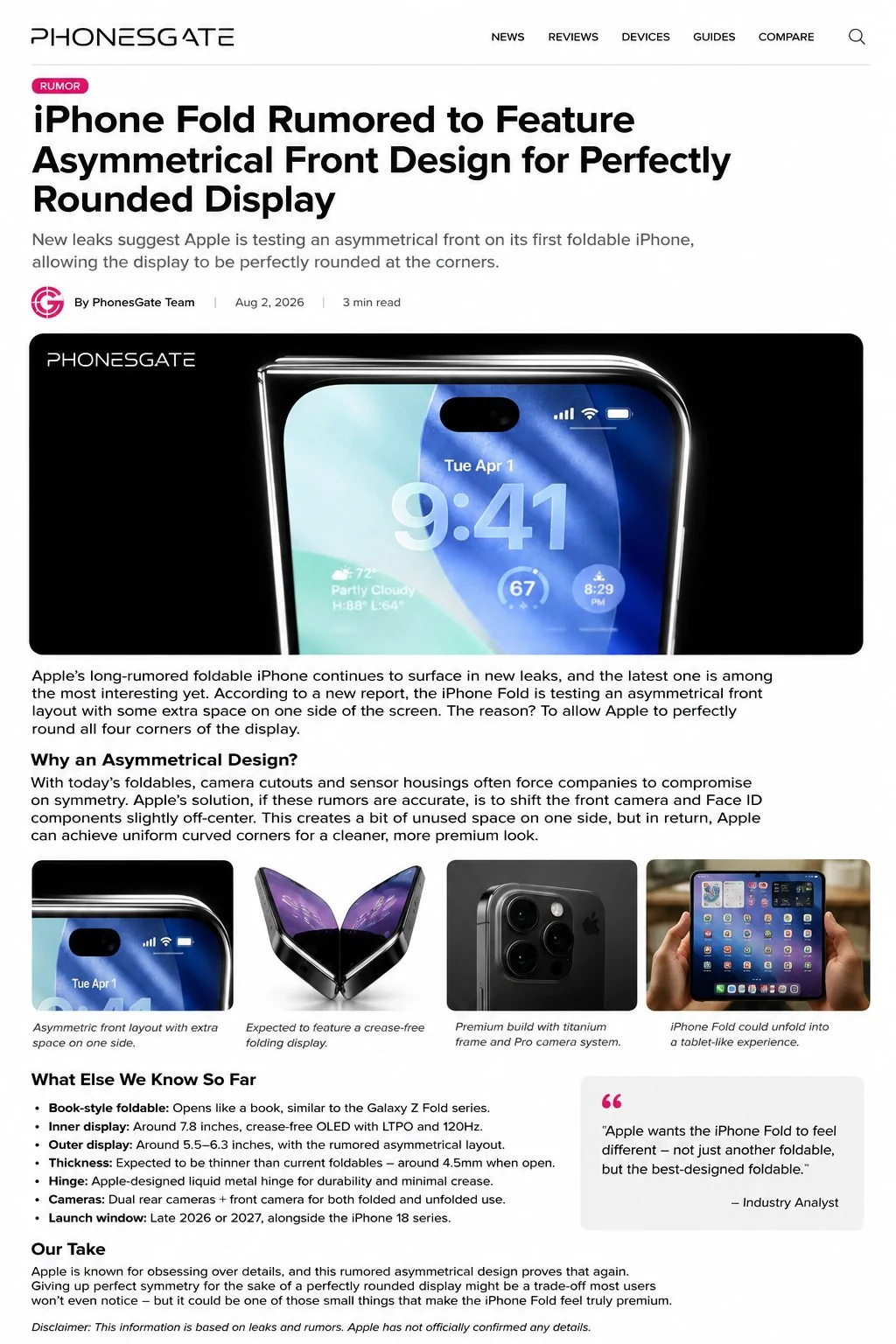
The asymmetrical-front rumor has believable design logic behind it. Foldables are mechanically uneven devices, and Apple may be willing to sacrifice a small amount of cover-screen area to achieve cleaner corners, better protection or more efficient internal packaging.
But the evidence is still weak. The exact claim currently appears to come from concept imagery and social-media discussion rather than a well-established supply-chain report. That distinction matters. We would not treat the render as proof of what Apple will ship.
What does appear more credible is the wider direction: a thin book-style foldable, a compact outer screen, a roughly 7.8-inch inner display, heavy focus on crease reduction and an extremely premium price. The asymmetrical front may become part of that story—or it may disappear as soon as more accurate hardware information emerges.
What to watch next
- More consistent reports about the exact outer-display dimensions and aspect ratio.
- Leaked cases, display protectors or manufacturing drawings that could confirm the corner geometry.
- Whether Apple uses Touch ID instead of Face ID to save internal space.
- Evidence about the hinge, crease depth and final unfolded thickness.
- Official launch timing and whether availability will be limited at first.
Final verdict
The rumored asymmetrical iPhone Fold front is an intriguing design idea, but it is not yet a confirmed leak. It could provide a technically sensible way to create more uniform rounded corners and manage the hinge-side constraints of a book-style foldable. It could also be nothing more than a concept artist’s interpretation.
For now, the most useful takeaway is not that Apple will definitely leave part of the front unused. It is that the company’s first foldable is likely to involve compromises that look very different from a normal iPhone. If Apple can turn those compromises into deliberate design choices, the iPhone Fold may still feel unmistakably like an Apple product—even if its front is not perfectly symmetrical.
FAQ
Has Apple confirmed the iPhone Fold?
No. Apple has not officially announced a foldable iPhone, its final name, specifications or launch date.
Is the asymmetrical outer display confirmed?
No. The claim currently comes from circulating social-media concept imagery and has not been independently confirmed by established reporting.
How large could the iPhone Fold displays be?
Current rumors commonly point to an outer display around 5.5 inches and an internal display around 7.8 inches, but those measurements remain unofficial.
When could the iPhone Fold launch?
Several reports point toward late 2026, though production difficulties could affect timing and availability.
How much could the iPhone Fold cost?
Analyst estimates generally place it in the $2,000 to $2,500 range, making it one of Apple’s most expensive mobile devices.