

A 10,000mAh battery used to belong in a power bank or a bulky rugged phone. OPPO just put one inside a mainstream-looking 5G phone. That is the headline behind the new A7 Pro Series, but the more interesting story is how normal the phones still look. The A7 Pro 5G brings an 8,000mAh battery, while the A7 Pro Max 5G pushes all the way to 10,000mAh without turning into a brick.

The A7 Pro Max is the model that immediately grabs attention: 10,000mAh, 80W charging, 27W reverse wired charging, a 1.5K AMOLED display, optical image stabilization on the main camera and IP69K protection. The standard A7 Pro is the more affordable option, but its own 8,000mAh battery is still enormous by mainstream-phone standards.
OPPO A7 Pro vs A7 Pro Max: the important differences
Feature OPPO A7 Pro 5G OPPO A7 Pro Max 5G Display 6.57" FHD+ AMOLED, 120Hz 6.78" 1.5K AMOLED, 120Hz Peak brightness 1,400 nits 1,800 nits Chipset Dimensity 6360 MAX Snapdragon 4 Gen 5 Main camera 50MP + 2MP mono 50MP OIS + 2MP mono Selfie camera 50MP, 100° ultra-wide 50MP, 100° ultra-wide Battery 8,000mAh 10,000mAh Charging 45W SUPERVOOC 80W SUPERVOOC Global-equivalent launch price* Approx. $417–$466 Approx. $613
Key takeaway
OPPO A7 Pro Series pushes mid-range battery capacity to a new level: 8,000mAh in the A7 Pro and 10,000mAh in the A7 Pro Max. We compare their AMOLED displays, 50MP selfie cameras, charging, durability and global-equivalent pricing.
*USD equivalents are converted from confirmed Malaysian launch pricing using the MYR/USD exchange rate on September 21, 2026. They are not official worldwide MSRPs and local pricing will vary.
The A7 Pro Max is basically a phone and a power bank in one
The defining specification is the 10,000mAh battery. The surprising part is not just the number; it is the packaging. OPPO lists the Pro Max at about 8.57mm thick and roughly 224–226g depending on color. That means it remains within the size and weight range of many large premium phones despite carrying dramatically more battery capacity.
7 min read
PhonesGate coverage from PhonesGate. Published Sep 22, 2026.

That changes the way we should think about mid-range endurance. A 5,000mAh battery used to be considered large. The Pro Max doubles that figure while still offering a polished AMOLED design rather than a ruggedized shell. OPPO also claims the battery is engineered to retain more than 80% capacity after six years under its own laboratory simulation, reinforcing the idea that this phone is designed around long ownership.
80W charging makes 10,000mAh practical
A massive battery is less useful if it takes forever to refill. The A7 Pro Max supports 80W SUPERVOOC, while the standard A7 Pro uses 45W. The Max also supports 27W reverse wired charging, which is unusually powerful for topping up earbuds, a smartwatch or even another phone.
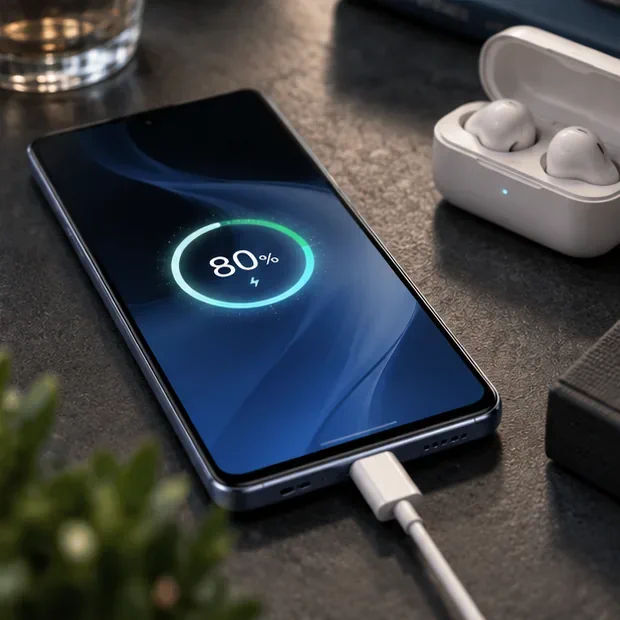
This is where the 10,000mAh capacity becomes more than a marketing number. With enough reverse-charging power, the phone can genuinely act as an emergency battery bank. For travelers or heavy users carrying several devices, that could be one of the most practical features in the whole package.
The Max also gets the better display
The A7 Pro uses a 6.57-inch FHD+ AMOLED display with a 120Hz adaptive refresh rate and brightness up to 1,400 nits. The Max moves to a larger 6.78-inch 1.5K AMOLED panel, keeps the 120Hz refresh rate and increases peak brightness to around 1,800 nits.
OPPO also advertises a 93.5% screen-to-body ratio and 1.65mm side bezels on the Max. That is important because the phone's battery-first identity could easily have resulted in a thick, utilitarian design. Instead, the display treatment helps it look closer to a modern premium handset.
The 50MP selfie camera is unusually ambitious
Both phones use a 50MP front camera with a 100-degree field of view. The camera can shift between 0.6x, 1x and 2x framing, and AI can automatically widen the shot when more people enter the frame. That makes the system especially useful for group selfies, travel photos and social content.

The Pro Max also gets a 50MP rear main camera with 2-axis OIS. Stabilization matters far more than another decorative camera ring because it can improve low-light consistency and handheld video. Neither model is positioned as a true camera flagship, but the Max has the more credible imaging package.
Two chipsets, two different priorities
The standard A7 Pro uses the MediaTek Dimensity 6360 MAX, while the A7 Pro Max uses the Snapdragon 4 Gen 5. These are efficiency-oriented mid-range platforms rather than flagship chips, which fits the philosophy of the series: long battery life, stable connectivity and everyday smoothness matter more here than benchmark records.
The Max also uses faster UFS 3.1 storage, while the A7 Pro uses UFS 2.2. That should help the Max feel quicker during app launches, large file transfers and installations even if neither phone targets enthusiast gaming performance.
OPPO is selling six-year longevity almost as hard as battery life
Both phones run ColorOS 16, and OPPO promotes what it calls 6-Year Smoothness Protection. The company says its scheduling, storage cleanup and long-term optimization are designed to keep the phones responsive over extended ownership.
No laboratory smoothness claim can guarantee how a phone will feel after years of apps, updates and storage use. But the strategy makes sense beside these huge batteries. If buyers keep the phones for longer, battery health, storage performance and software maintenance become more important than a short-term benchmark win.
IP69K makes the series unusually tough
The A7 Pro Series is also marketed with IP69K water and dust resistance and military-grade shock resistance. IP69K adds resistance to high-pressure, high-temperature water jets under controlled test conditions, going beyond the everyday splash protection found on many mid-range phones.
That does not make the phones indestructible, and warranty terms can vary by market, but it gives the series an appealing combination: rugged-style durability without rugged-phone styling.
The design keeps things playful

Surfing Blue uses a wave-inspired rear finish, while the Max is also offered in Lunar Black. OPPO's Horizontal Smile Deco camera area includes a multi-color breathing light that can react to charging, calls, notifications and music.
It is a small feature, but it helps stop the phone from feeling like a purely practical battery monster. OPPO is clearly trying to make the A7 Pro Max feel social and youthful rather than industrial.
Global-equivalent pricing: roughly $417 to $613
The first confirmed retail prices are RM1,699 for the A7 Pro 6GB/256GB, RM1,899 for the A7 Pro 8GB/256GB and RM2,499 for the A7 Pro Max 8GB/256GB. Converted to U.S. dollars at the September 21, 2026 MYR/USD exchange rate, those figures are approximately $417, $466 and $613.
Those are the most useful global-equivalent prices right now, but they are not official global MSRPs. Local taxes, storage configurations, launch promotions and import costs can make the final price substantially different in each market.
Which model makes more sense?
The A7 Pro is the value choice. An 8,000mAh battery, 120Hz AMOLED, 50MP ultra-wide selfie camera, 5G and strong water resistance at a global-equivalent price starting around $417 is already an aggressive combination.
The A7 Pro Max is the more interesting device if you want the unusual hardware. The 10,000mAh battery, 80W charging, 27W reverse charging, OIS, brighter 1.5K display and faster storage are real upgrades rather than cosmetic differences.
PhonesGate verdict
The OPPO A7 Pro Series is interesting because it shifts the mid-range conversation away from raw performance and toward endurance. The standard A7 Pro already offers an unusually large 8,000mAh battery. The Max goes further with 10,000mAh and enough charging flexibility to behave like a phone and a power bank in one.
Just as importantly, OPPO did not sacrifice the rest of the experience. Both phones have 120Hz AMOLED displays, ambitious 50MP front cameras, strong durability ratings and a long-term smoothness focus. The Max adds the sharper display, OIS, faster storage and much faster charging.
If international pricing stays close to the converted launch equivalents, the A7 Pro could become a strong endurance-focused mid-ranger, while the A7 Pro Max could be one of the most distinctive battery-first smartphones of 2026.
Explore more current OPPO devices in the PhonesGate OPPO database.
Editorial disclosure: PhonesGate has not physically tested the A7 Pro Series for this article. The images are original AI-generated editorial visualizations created for PhonesGate. Global-equivalent USD pricing is converted from confirmed Malaysian launch pricing and is not an official worldwide MSRP.