

Smartphone flagships have spent years competing on camera counts, benchmark scores and ever-brighter displays. Oppo’s Find X10 series is taking a different approach: make the camera hardware unusually ambitious, then pair it with a battery that would have looked impossible in a mainstream flagship only a few years ago.
Quick Read
Oppo has confirmed a dual-200MP camera direction for the Find X10 and a triple-200MP focus for the Find X10 Pro Max. The standard Find X10 also gets an 8,000mAh Glacier battery and 0.99mm symmetrical bezels. The important story is not the megapixel count alone: Oppo is combining resolution with stronger stabilization, Hasselblad imaging, LUMO processing and a much larger battery than most mainstream flagships.
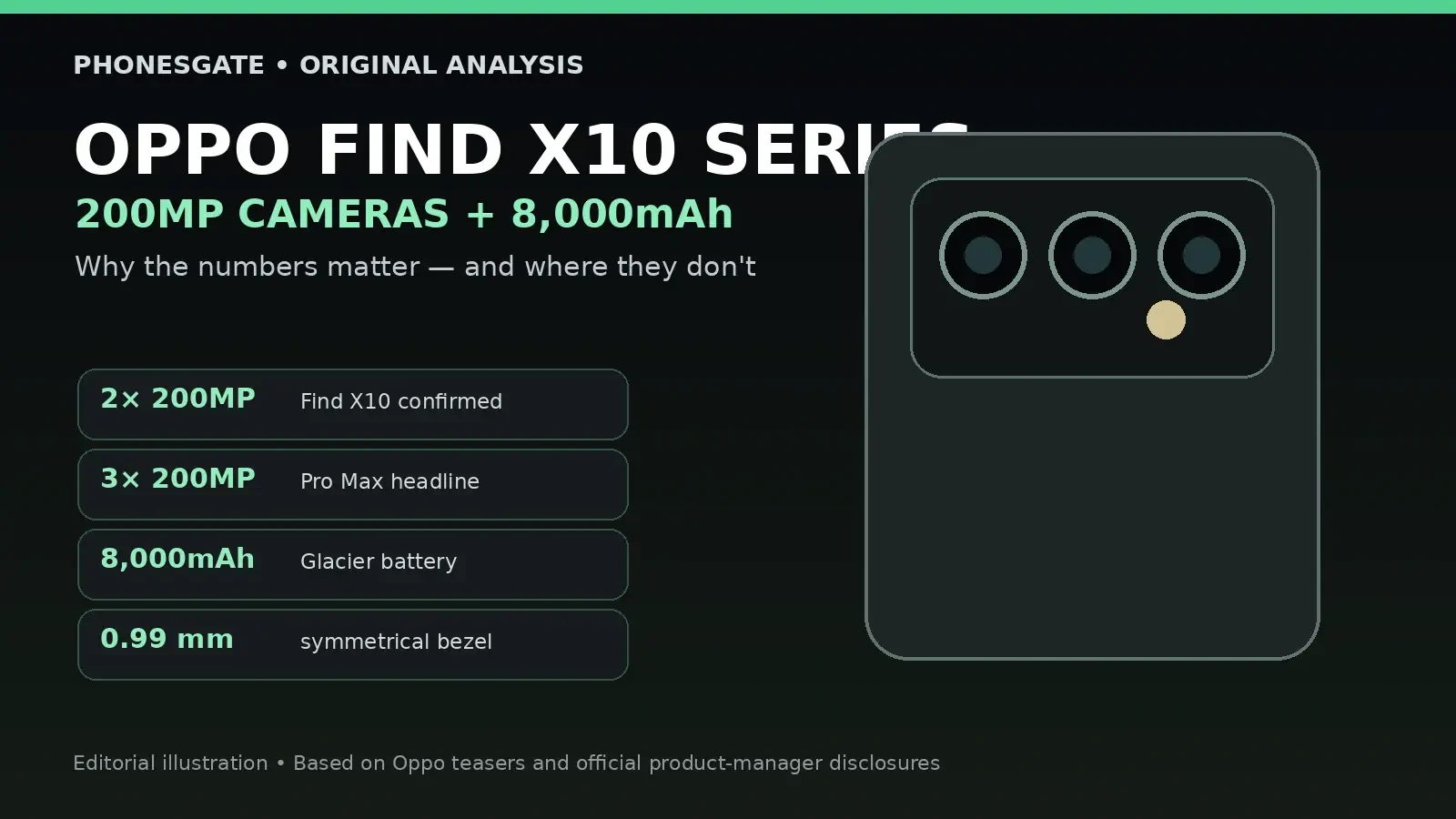
The headline numbers are dramatic. Oppo has confirmed that the standard Find X10 uses two 200MP rear cameras, while the Find X10 Pro Max is being positioned around a triple-200MP camera system. The standard model also gets an 8,000mAh Glacier battery and four-sided bezels measuring just 0.99mm.
Key takeaway
Oppo is pushing the Find X10 series around dual- and triple-200MP camera systems, an 8,000mAh Glacier battery and 0.99mm bezels. The real story is how these upgrades could improve telephoto quality, camera consistency and everyday endurance — not the headline numbers alone.
That combination makes the Find X10 more interesting than a typical pre-launch specification dump. The real question is not whether 200MP sounds impressive. It is whether Oppo is using those numbers to solve actual camera problems: stabilization, dynamic range, telephoto quality, color consistency and long-term usability.
One-Minute Read
The Find X10 series is shaping up as Oppo’s most aggressive camera-and-battery flagship generation yet. The standard Find X10 has two 200MP rear cameras, including a 200MP telephoto, while the Pro Max is being positioned around three 200MP cameras. Oppo has also disclosed a 0.99mm four-sided bezel on the Find X10 and an 8,000mAh Glacier battery designed for long-term durability. Some details — including final global pricing, charging specifications and certain Pro Max sensor details — remain pre-launch reports rather than settled retail specifications.
9 min read
PhonesGATE coverage from PhonesGATE. Published Sep 14, 2026.
This topic is not already duplicated on PhonesGate
Before creating this article, we checked the current PhonesGate news footprint for a dedicated Oppo Find X10 feature and did not find an existing PhonesGate article focused on this specific camera-and-battery analysis. That makes this a useful addition rather than another rewrite of content already on the site.
The standard Find X10 is getting two 200MP cameras
The standard Find X10 is important because Oppo is not reserving its most interesting imaging idea for the most expensive model. Oppo product manager Zhuo Shijie has disclosed a 200MP main camera with an f/1.6 aperture and CIPA 6.0-rated stabilization, paired with a 200MP telephoto camera with an f/2.6 aperture and CIPA 7.0 stabilization.
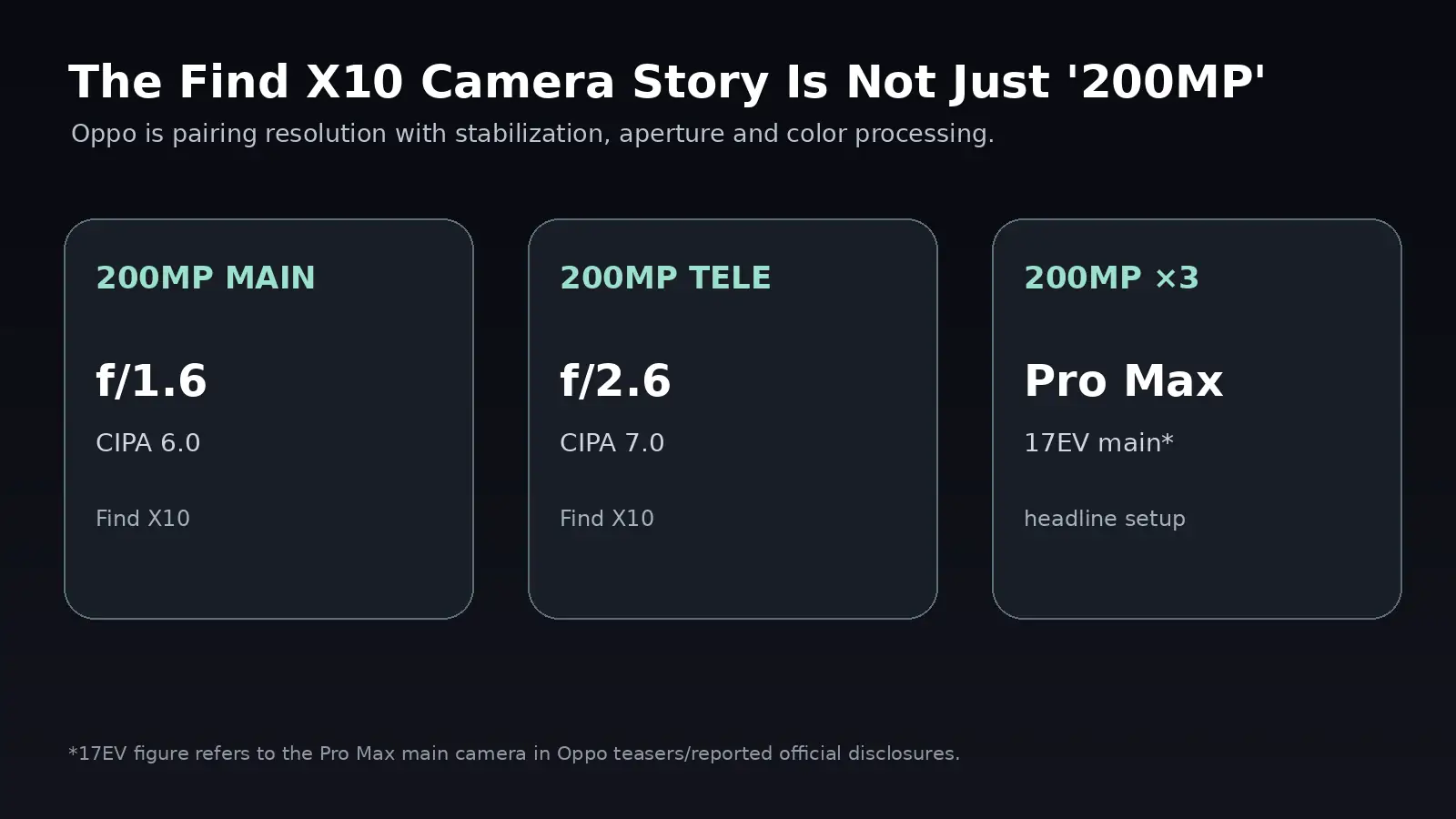
That matters because telephoto quality is often where standard flagships fall behind their “Ultra” or “Pro Max” siblings. A high-resolution telephoto sensor can give Oppo more flexibility for optical-range detail, crop-based zoom and computational fusion. The stabilization figures are equally important: long focal lengths magnify hand movement, so a high-resolution sensor is only useful if the camera can hold detail consistently.
Oppo is also combining the hardware with its Hasselblad-branded imaging system, a second-generation Danxia color-restoration lens and the company’s LUMO native light-and-shadow engine. According to Oppo’s disclosures reported ahead of launch, the system targets natural skin tones, stronger backlit detail and more consistent color rather than the aggressively processed look some flagship cameras produce.
Why three 200MP cameras on the Pro Max is more than a marketing stunt
The Find X10 Pro Max takes the same philosophy further. Oppo has already teased a three-camera setup built around three 200MP sensors. Pre-launch reporting indicates that the main camera is based on a large Samsung ISOCELL sensor, with additional high-resolution ultra-wide and periscope telephoto hardware.
There is an obvious danger here: three “200MP” labels can become pure spec-sheet theatre. But if Oppo uses similarly capable sensors across main, ultra-wide and telephoto focal lengths, the benefit is consistency. Flagship camera systems still often show visible quality drops when switching lenses, especially in low light or difficult HDR scenes.
A more balanced sensor strategy could make zoom transitions, color, texture and dynamic range feel less like three separate cameras stitched together by software.
The 8,000mAh battery may be the more important upgrade
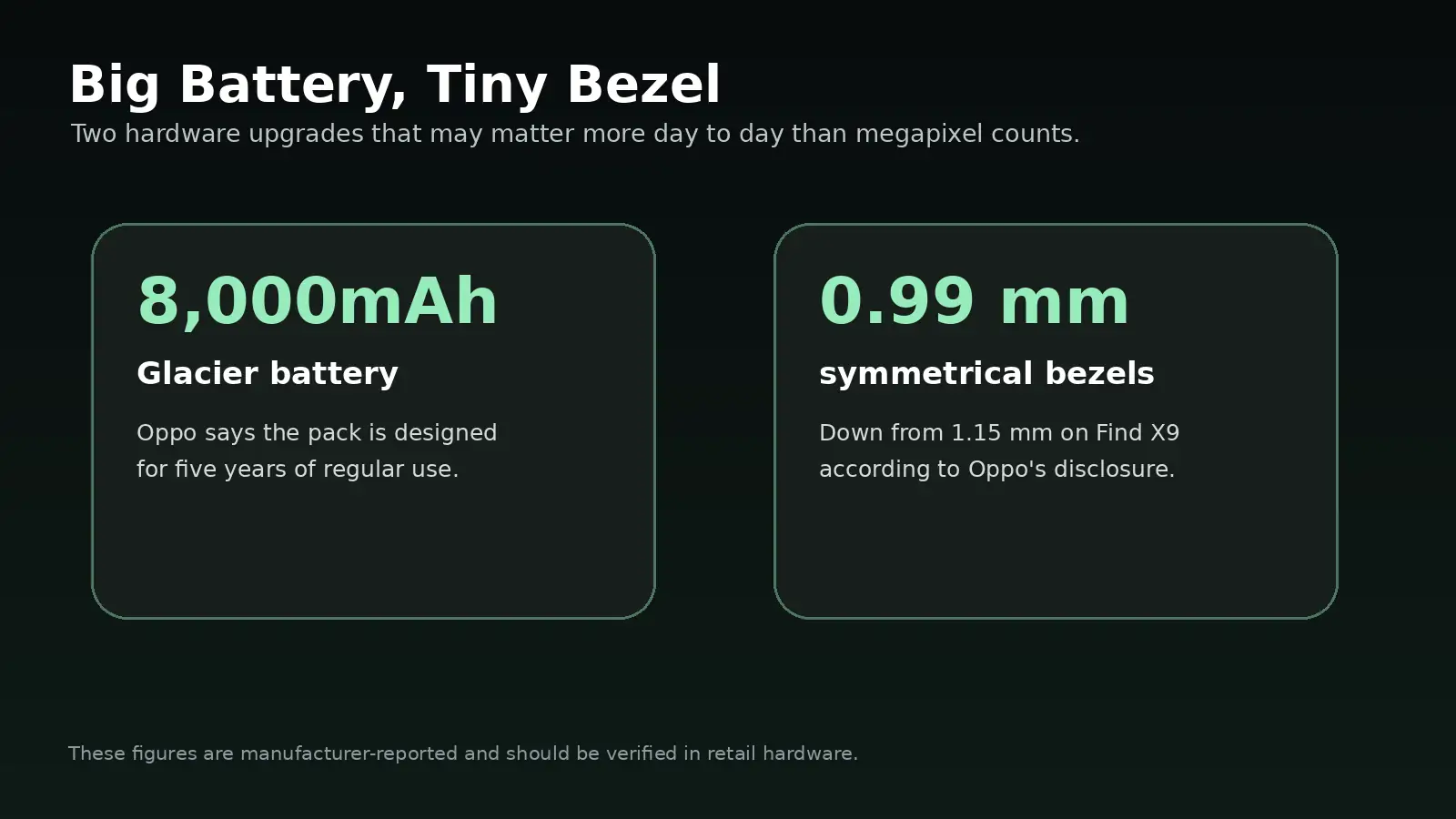
The camera specifications will attract attention, but the 8,000mAh Glacier battery could be the feature users appreciate every single day. Oppo says the battery is designed to maintain useful health across five years of regular use.
That number is striking because most premium slab phones have historically clustered far below this capacity. Silicon-carbon battery chemistry and denser packaging are allowing Chinese manufacturers to push capacity upward without making phones comically thick.
The practical value is obvious. Camera-heavy flagships consume a lot of power: high-refresh displays, computational photography, 5G, AI workloads and long video recording sessions all punish battery life. A much larger battery gives Oppo more room to absorb those workloads without forcing users into constant power-saving behavior.
Charging details reported ahead of launch include 80W wired and 50W wireless support on some Find X10 models, but PhonesGate is treating those figures as pre-launch reporting until Oppo publishes final retail specifications for each market.
0.99mm bezels show there is still room to improve the normal smartphone
The Find X10 is also getting symmetrical four-sided bezels measuring 0.99mm according to Oppo’s product manager. Oppo says it reduced the border from 1.45mm on the Find X8 and 1.15mm on the Find X9.
This is not a revolutionary feature, but it is a good reminder that slab phones are not finished evolving. Once performance becomes fast enough and cameras become consistently good, industrial design details like border symmetry, weight distribution and screen-to-body ratio become more meaningful.
A sub-1mm bezel will not transform what the phone can do, but it can make a large-screen flagship feel more compact and visually refined.
Confirmed information and pre-launch reporting should not be mixed
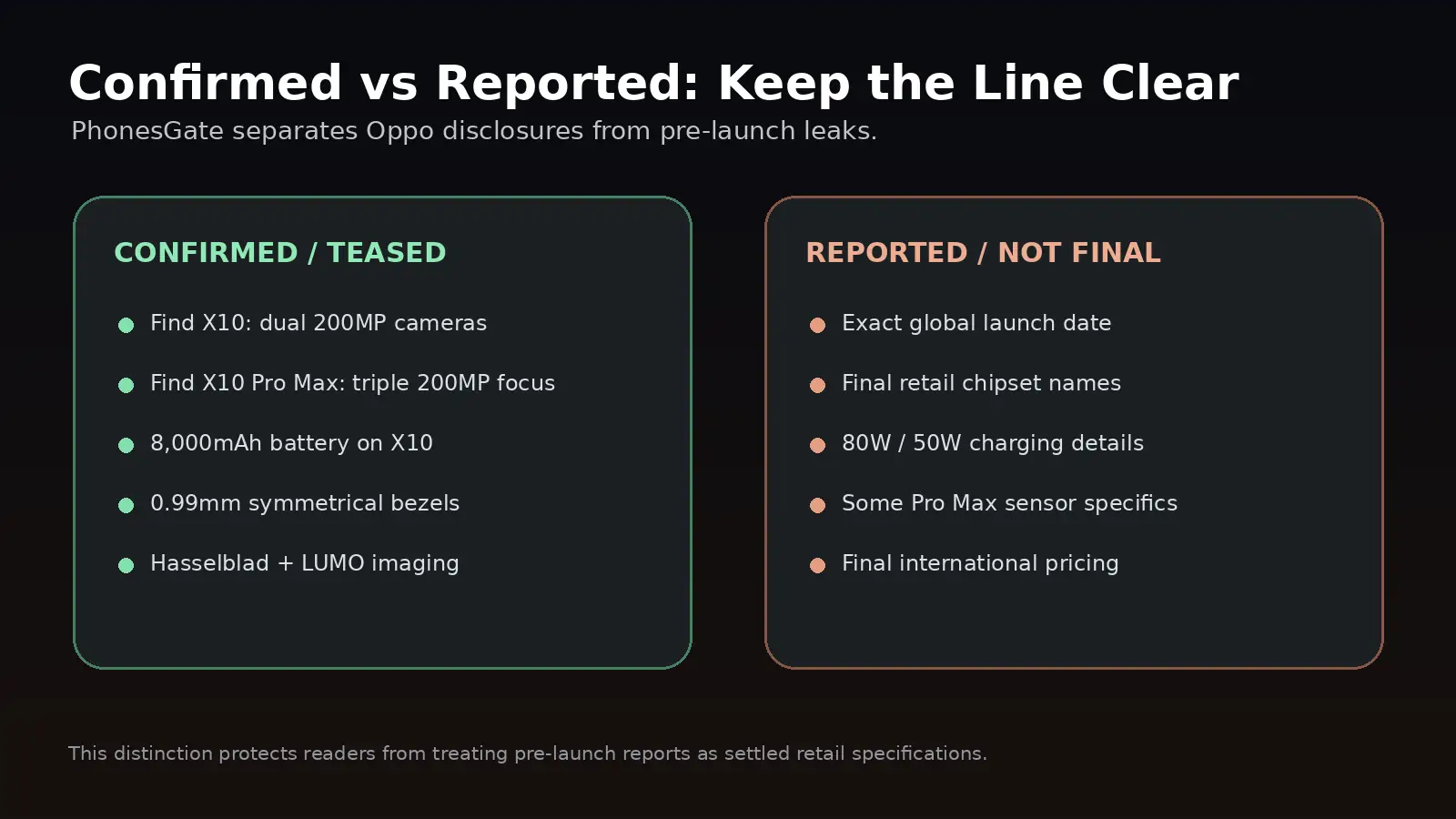
This distinction is especially important for an article published before the full launch. Oppo has directly teased or disclosed several major Find X10 features, including the dual-200MP standard model, the Pro Max camera direction, the large battery and the ultra-thin bezels.
Other details remain less certain. Exact international launch dates, final global pricing, chipset branding for every market and some Pro Max sensor specifications have appeared through certifications, benchmark databases or leakers rather than complete retail spec sheets.
PhonesGate therefore treats those details as reported, not confirmed. That is better for readers and better for long-term SEO quality because the article does not become inaccurate the moment a pre-launch specification changes.
What the Find X10 strategy says about the 2026 flagship market
The Find X10 series arrives at an interesting point. Apple is pushing the iPhone 18 family, Samsung is extending the Galaxy S26 generation, Vivo is preparing its own camera-heavy X500 lineup, and foldables are taking more attention at the ultra-premium end.
Oppo cannot differentiate by saying “our processor is faster” because every modern flagship is already extremely fast for normal use. The company needs a clearer reason to exist.
Its answer appears to be camera consistency + battery endurance + premium display packaging.
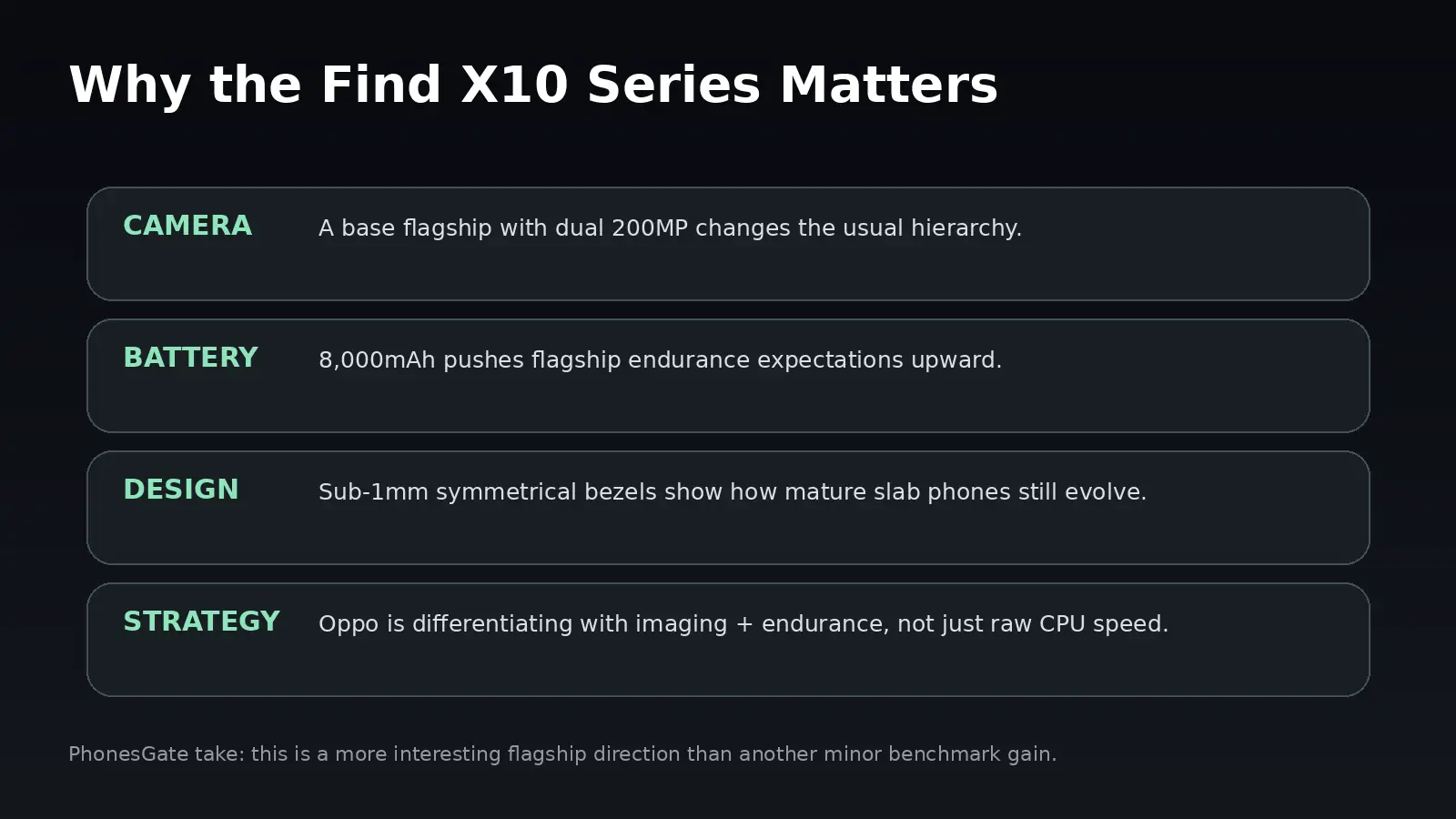
That is a smarter positioning strategy than chasing a small benchmark lead. Camera performance and battery endurance are two things people notice every day, and they are easier to explain than a processor score that means little outside enthusiast circles.
Will 200MP actually make photos better?
Not automatically. Megapixel count alone does not determine image quality. Sensor size, lens quality, aperture, stabilization, autofocus, image processing and shutter behavior all matter.
A 200MP sensor can provide more data for cropping and pixel binning, but poor processing can still produce over-sharpened textures or inconsistent colors. Oppo’s emphasis on Hasselblad tuning, LUMO processing and its Danxia color system suggests the company understands that problem.
The real test will be whether the Find X10 can keep detail and color consistent across all rear cameras in difficult lighting. That is a more useful benchmark than simply counting megapixels.
Who should pay attention to the Find X10?
The standard Find X10 looks particularly interesting for buyers who want serious telephoto hardware without automatically moving to the most expensive model in the lineup. The combination of dual 200MP cameras and an 8,000mAh battery gives the base flagship a stronger identity than a typical “smaller Pro Max.”
The Pro Max, meanwhile, is aimed at people who want Oppo’s most ambitious camera setup and are willing to pay for it.
Until pricing is official, it is impossible to judge value properly. But the hardware direction is already clear enough to make the series worth watching.
PhonesGate verdict
The Oppo Find X10 series looks interesting because its biggest upgrades are easy to understand without a benchmark chart.
Two 200MP cameras on the standard model address a real weakness in many base flagships: telephoto quality. Three 200MP cameras on the Pro Max could reduce quality differences between focal lengths. An 8,000mAh battery directly targets endurance. And 0.99mm bezels show Oppo is still refining the physical design of a conventional flagship.
The risk is obvious: giant numbers create giant expectations. If the camera software cannot make the sensors work together naturally, “600 megapixels” will be little more than a headline.
But if Oppo gets the processing right, the Find X10 series could be one of the clearest examples of where premium Android phones are heading next: less obsession with synthetic performance, more focus on cameras, batteries and the things users actually feel.
You can browse other current and upcoming smartphones in the PhonesGate device database.
Sources and methodology
- Gizmochina — Oppo Find X10 camera, battery and bezel details based on Oppo product-manager disclosures
- Gizmochina — Find X10 series camera teasers and September launch confirmation
- Gizmochina — Find X10 lineup reservations and model confirmation
- Notebookcheck — additional context on Oppo’s pre-launch camera teasers
Editorial disclosure: PhonesGate has not physically tested the Oppo Find X10 series for this article. Confirmed manufacturer disclosures are separated from leaks and pre-launch reports. All visuals in this package are original PhonesGate editorial graphics, not product photographs.