

Review methodology correction — September 26, 2026
PhonesGate did not perform the week-long test described in the supplied notes used for the original article. The experiential observations below belong to an unnamed external tester and cannot be independently verified as PhonesGate testing. They are retained only as attributed context; manufacturer specifications and independently documented facts should carry greater weight.
The Samsung Galaxy Watch 9 may be the cheaper option in Samsung’s current smartwatch lineup, but according to a week of supplied external testing notes it does not feel like the compromised choice. The watch delivers flagship-level performance, a premium display, broad health tracking and unexpectedly strong battery life. The bigger question is whether those strengths are enough to make the much more expensive Galaxy Watch Ultra 2 harder to recommend for most buyers.
This review is based on the supplied first-week testing notes and should be read as an early real-world assessment rather than a final long-term battery or durability verdict.
Key takeaway
Samsung Galaxy Watch 9 review covering battery life, charging, GPS and step accuracy, performance, design, health tracking and value versus the Galaxy Watch Ultra 2.
Battery life is the first big surprise
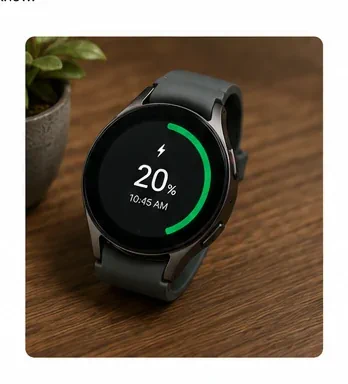
The first full-charge test produced one of the strongest early impressions. Starting at 100%, the Galaxy Watch 9 lasted 37 hours and 15 minutes before shutting down. That worked out to roughly 2.68% battery drain per hour during a run that included normal daily use and a GPS-tracked run of just over 5K.
The more impressive part is the configuration. No battery-saving mode was enabled, health-tracking features remained active and the always-on display stayed on. The watch was also still in its early calibration period, which means the result was achieved before the software had fully adapted to usage patterns.
8 min read
Samsung coverage from PhonesGate Reviews. Published Aug 17, 2026.
The supplied test notes also highlight a small hardware change from the previous generation: battery capacity rises from 435mAh on the Galaxy Watch 8 to 445mAh on the Watch 9. That is not a dramatic increase, so the early endurance result is more interesting than the capacity number alone.
For most users, the practical takeaway is straightforward: around two days of mixed use appears realistic without disabling the features that make a smartwatch useful.
Charging is the biggest early concern
Battery life may be encouraging, but charging performance is less convincing. Samsung is described in the source material as advertising up to 10W charging, yet the observed test repeatedly stayed below that level. In many cases, measured charging power reportedly sat around 2W or lower and only occasionally climbed beyond 5W.
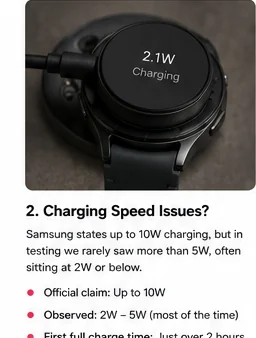
The first full charge took a little over two hours, compared with an expected figure around 90 minutes in the supplied review notes. That is not enough evidence to declare a hardware defect, especially from one early test cycle, but it is something worth watching closely.
There is one positive comparison: the Watch 9 still charged noticeably faster than the Galaxy Watch Ultra 2 in the same early testing context. So the problem is not that the Watch 9 is uniquely slow; rather, Samsung’s current charging behavior may simply be falling short of the headline figure in real-world use.
GPS and heart-rate tracking are strong — step counting is not
For running, the Galaxy Watch 9 performed very well in the supplied test. GPS, heart rate, calories burned and heart-rate-zone behavior were all described as effectively identical to the Galaxy Watch Ultra 2. For a cheaper watch, that is exactly what you want to see: no meaningful compromise in the metrics that matter during a workout.
The strange weakness is phantom steps. During a car journey, the Watch 9 reportedly added several hundred steps even though the wearer was driving. This is not catastrophic, but it undermines confidence in daily activity totals.
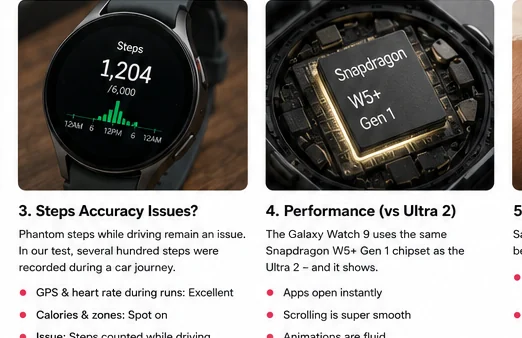
The frustrating part is that Samsung’s ecosystem already understands contextual information such as driving and parking. That makes the step-counting issue feel more like an algorithmic problem than a missing hardware capability.
Performance may be the Watch 9’s strongest argument
The Watch 9’s responsiveness is one of the clearest reasons to choose it. The source review describes the watch as the smoothest Samsung smartwatch the tester had used, with fluid scrolling, fast app launches and a premium overall feel.
More importantly, the Watch 9 is described as using the same Snapdragon Elite-class processor as the Galaxy Watch Ultra 2. That means the cheaper model is not positioned as a lower-performance smartwatch. In day-to-day use, there is effectively no performance penalty for choosing the standard model.
There is also a dedicated onboard MPU for gestures and local processing. The supplied notes specifically mention raise-to-talk interaction for Gemini and a mix of on-device and phone-assisted Galaxy AI processing.
The design barely changes — and that is both good and bad
Samsung has taken a conservative approach to the exterior. The Galaxy Watch 9 is described as looking almost identical to the Watch 8, with most of the meaningful changes happening under the surface.
That can be read two ways. On one hand, the design is familiar and premium, with two physical buttons, a solid metal finish and compatibility with existing strap options. On the other, anyone hoping for a visual redesign may find Samsung’s approach lazy.
Compared with the Ultra 2, the standard Watch 9 gives up the third hardware button and the more rugged Ultra styling. In return, it is thinner, lighter and likely more comfortable for all-day and overnight wear.
The display is familiar but better tuned
Peak brightness remains at 3,000 nits according to the supplied review notes, but Samsung appears to have improved the panel’s visual character. The display is described as looking more vibrant, more punchy and slightly more premium than before.
That may matter more than chasing an even larger brightness figure. A smartwatch display needs outdoor visibility, but excessive brightness can become an unnecessary battery trade-off once readability is already good.
Health tracking is broad, useful and increasingly dependent on sleep data
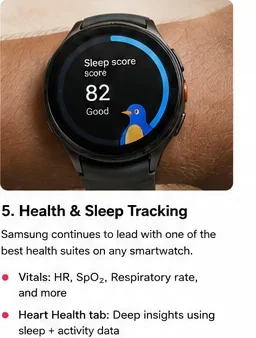
Samsung continues to differentiate its watches with the breadth of the health platform. The Galaxy Watch 9 adds or emphasizes several features, including a new fitness index, Vitals, a heart health section, daily cardio load and a new hearing-health feature.
The fitness index appears to be one of the more immediately useful additions because it consolidates existing activity metrics into scores and targets. The supplied example shows strong cardio performance but a much lower strength score, making the feature useful as a simple snapshot of training balance.
Vitals and heart-health insights rely heavily on sleep data. That means the Galaxy Watch 9 makes the most sense for users who are prepared to wear it overnight consistently. If you remove the watch every night, several of Samsung’s newest health features become much less useful.
The daily cardio-load feature is more questionable in its current form. In the supplied testing, 5–6K runs could register below target while 10K runs jumped dramatically above target, leaving a narrow middle ground. That may improve as the watch learns the user’s routine, but it is not yet convincing enough to treat as a perfectly calibrated training tool.
Bluetooth 6.0 and software polish
The source material also highlights Bluetooth 6.0 as one of the hardware changes. The practical expectation is better wireless efficiency and improved connection behavior when moving farther from the paired phone, although long-term testing would be needed to quantify the real battery effect.
Software presentation is another strength. The new One UI watch experience and updated watch faces give the Watch 9 a more polished feel without forcing users into a completely new interaction model. Older watch faces remain available, and third-party options continue to expand customization.
Galaxy Watch 9 vs Ultra 2: which one makes more sense?
The Ultra 2 still has reasons to exist. It offers the more rugged design, extra hardware controls and the appeal of Samsung’s highest-end smartwatch. But the Watch 9 makes the value equation uncomfortable for the Ultra because it delivers much of the same performance and health experience at a lower price.
For most users, comfort, battery life, health tracking and smooth performance matter more than the Ultra’s additional hardware button or more extreme design. That makes the standard Watch 9 the more rational recommendation even if the Ultra remains the more exciting enthusiast product.
PhonesGate verdict
The Galaxy Watch 9 looks like Samsung’s sensible flagship. It does not reinvent the exterior, and early charging behavior is disappointing, but almost everything else lands well: battery life is strong, workout tracking is excellent, performance is flagship-level and the health suite remains one of Samsung’s biggest advantages.
The phantom-step issue and inconsistent cardio-load behavior show that the software is not perfect. Even so, the Watch 9 appears to deliver the parts of the Ultra 2 that most people actually care about, while being thinner, more comfortable and easier to justify financially.
If the charging behavior improves with firmware and longer-term testing confirms the initial battery result, the Galaxy Watch 9 may end up being the easiest Samsung smartwatch to recommend this generation.