

Samsung’s Galaxy Watch 9 and Galaxy Watch 8 are so similar from the outside that many people would struggle to tell them apart. Put them side by side, however, and the real story is under the hood: Samsung has changed the processor, increased battery capacity and extended the newer watch’s long-term value.
That makes this comparison less about which watch is objectively better—the Galaxy Watch 9 is the newer model—and more about a practical buying question: are the changes large enough to justify upgrading from a Galaxy Watch 8?
Design: almost impossible to tell apart
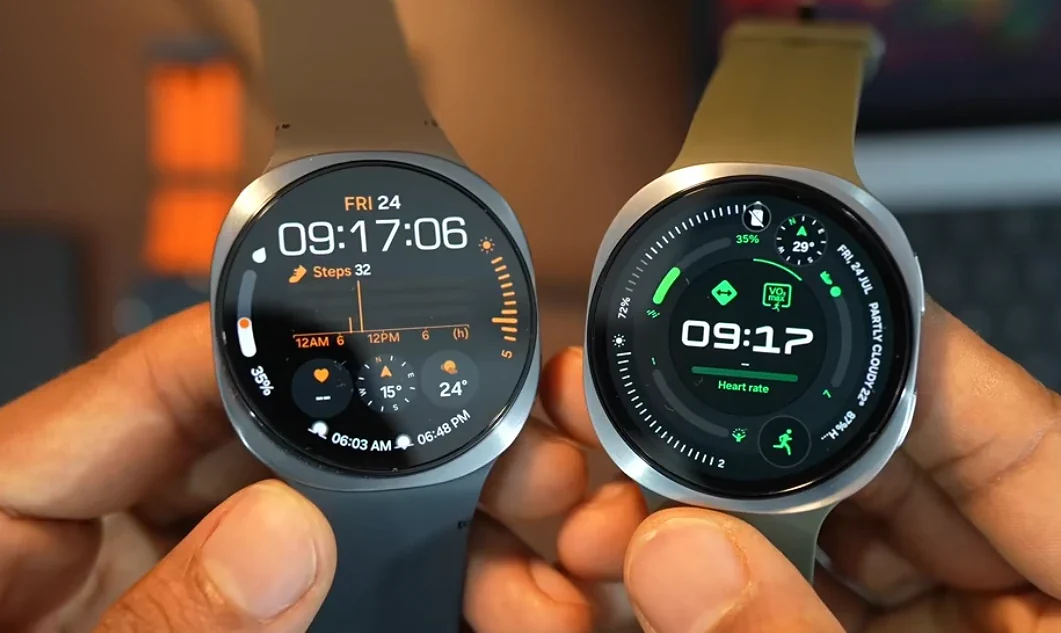
The supplied hands-on comparison makes the similarity obvious. From the front, sides and sensor area, the two watches follow essentially the same visual language. Button placement and speaker openings are familiar, and the overall shape is unchanged enough that this does not feel like a visual generational leap.
Key takeaway
Galaxy Watch 9 vs Galaxy Watch 8 compared across design, Snapdragon vs Exynos performance, battery, display, health features and upgrade value.
The easiest clue is the strap. The Watch 8 shown in the comparison has distinctive stitching, while the Watch 9 strap uses a cleaner, flatter treatment with a different design detail. That is a small change rather than a redesign.
The biggest upgrade is the processor
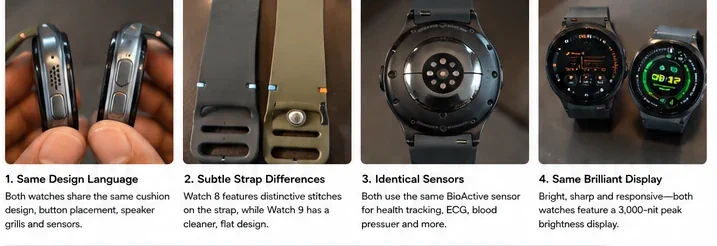
This is where the Watch 9 becomes more interesting. Samsung’s current comparison information lists the Galaxy Watch 9 with Snapdragon Wear Elite, while the Watch 8 uses Samsung’s Exynos W1000 3nm five-core processor. Both models pair the chip with 2GB of memory and 32GB of storage.
6 min read
Samsung coverage from PhonesGate Reviews. Published Aug 18, 2026.
In the supplied side-by-side test, the immediate difference was not dramatic. Apps opened quickly on both watches and normal navigation felt similarly responsive. That is important: buyers should not expect the Watch 8 to suddenly feel slow simply because a newer processor exists.
The more compelling argument is longevity. A newer, more efficient platform can matter more after several years of software updates than during the first few minutes of a hands-on test. For someone keeping a smartwatch for four or five years, that potential headroom matters more than a small benchmark advantage today.
Display, memory and durability: very little changes
Samsung’s official Watch 8 specifications confirm 2GB RAM, 32GB storage, a Super AMOLED display reaching up to 3,000 nits, sapphire crystal protection and 5ATM/IP68 durability with MIL-STD-810H testing. The Watch 9 retains the same broad formula rather than using the new generation to reinvent the display or ruggedness story.
That is good news for Watch 8 owners: your existing hardware has not suddenly become obsolete. It is also why this upgrade decision is difficult. Many of the things users interact with every day already feel flagship-grade on the previous generation.
Battery: bigger, but not a revolution
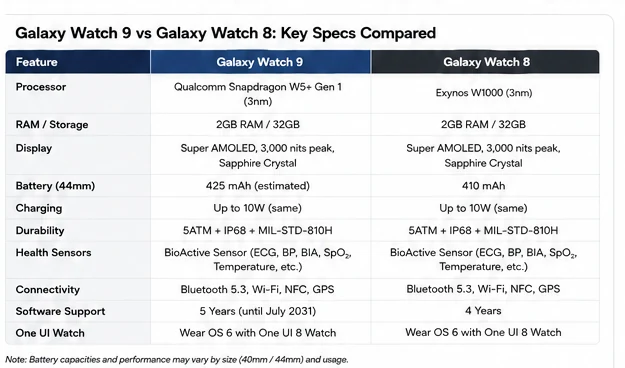
Battery capacity gets a measurable bump. Samsung’s comparison data lists the Watch 9 at 390mAh for the 40mm model and 445mAh for the 44mm model. The Watch 8 is listed at 325mAh and 435mAh respectively.
The 44mm difference is therefore modest, while the 40mm model receives a more noticeable capacity increase. The supplied hands-on comparison cautiously predicts a small real-world improvement rather than a completely different battery experience. That is the right expectation until longer-term testing establishes the exact endurance advantage.
If your Watch 8 already comfortably reaches the end of your normal day, battery capacity alone is unlikely to justify buying the Watch 9.
Health and AI: newer hardware, but software overlap matters
Samsung has already built a deep health platform around ECG, blood-pressure monitoring where supported, body composition, sleep analysis and fitness tracking. The Watch 9 continues that approach while putting more emphasis on AI-assisted interpretation, sleep insights, energy information and coaching.
But there is an important caveat for an upgrade comparison: software features can migrate backwards. Samsung’s official model comparison already shows considerable overlap between Watch 9 and Watch 8 health features, including Energy Score, sleep guidance, Running Coach, vascular load and Antioxidant Index.
That means buyers should not assume every software feature demonstrated on the Watch 9 will remain exclusive to it. The hardware platform and length of future support are stronger reasons to choose the newer watch than a feature that may arrive on an older model through an update.
Galaxy Watch 9 vs Watch 8: what actually changes?
Feature Galaxy Watch 8 Galaxy Watch 9 Processor Exynos W1000, 3nm, 5-core Snapdragon Wear Elite RAM / Storage 2GB / 32GB 2GB / 32GB Display Super AMOLED, up to 3,000 nits Similar flagship display approach Battery (40mm) 325mAh 390mAh Battery (44mm) 435mAh 445mAh Durability 5ATM + IP68 5ATM + IP68 Core health platform Extensive Samsung Health suite Extensive Samsung Health suite + newer AI emphasis Design Current Samsung cushion-style design Very similar; subtle strap differences
Should Galaxy Watch 8 owners upgrade?
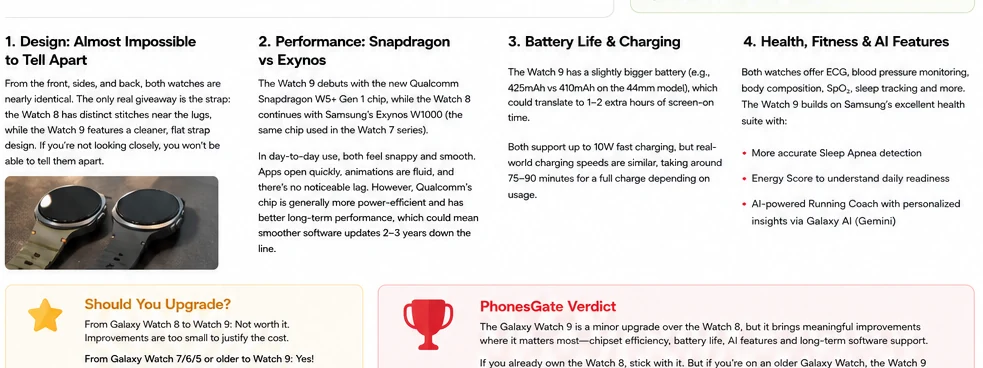
For most people, no. That is the clearest conclusion from this comparison. The Watch 9 is better on paper, but the areas that define everyday use—display quality, general responsiveness, storage, durability and the basic health experience—remain close enough that replacing a one-generation-old Watch 8 is difficult to justify.
The calculation changes if your Watch 8 battery has degraded, you receive an unusually strong trade-in offer, or you specifically want the newer Snapdragon platform for long-term ownership. Otherwise, keeping the Watch 8 is the financially smarter move.
Coming from Watch 7, Watch 6 or Watch 5? Watch 9 makes much more sense
For owners of older Galaxy Watches, the recommendation flips. The Watch 9 gives you Samsung’s latest hardware platform, the larger battery configuration, current health and AI direction and a fresh software-support runway. The cumulative jump across multiple generations is much easier to feel and justify.
PhonesGate verdict
The Galaxy Watch 9 is the better watch, but it is not a necessary Watch 8 replacement. Samsung has focused on refinement rather than reinvention. The Snapdragon Wear Elite platform is the most meaningful change because it improves the Watch 9’s long-term proposition, while the battery increase and evolving AI features add incremental value.
If you already own a Galaxy Watch 8 and it works well, keep it. You are not missing enough to justify paying for another watch after only one generation. If you are upgrading from a Watch 7, Watch 6, Watch 5 or an even older model, the Watch 9 is the obvious target because you benefit from several generations of accumulated improvements at once.
That makes the Watch 9 less of an irresistible annual upgrade and more of what a mature smartwatch should be: a polished long-term choice for people whose current watch is actually ready to be replaced.