

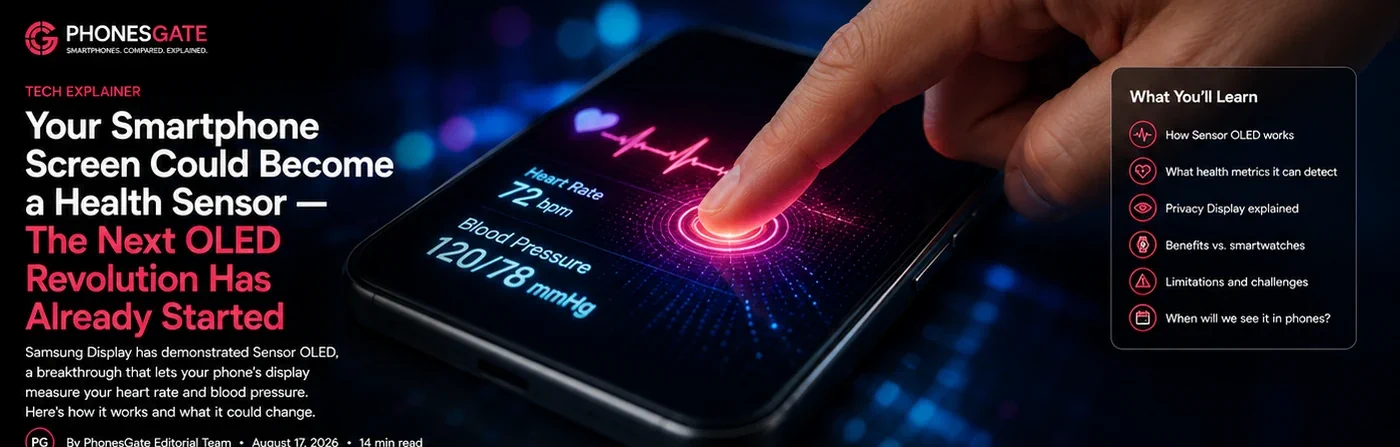
Your next smartphone display may do much more than show pixels and read fingerprints. Samsung Display has demonstrated Sensor OLED technology that integrates biometric sensing directly into the panel itself, turning the screen into an active measurement surface rather than a passive window.
The concept matters because it changes where health sensing happens. Instead of relying only on a smartwatch, ring or separate optical sensor, the phone display itself could become capable of measuring certain biometric signals when a user places a finger on the screen.
What is Sensor OLED?
Sensor OLED is a display architecture that integrates light-sensitive elements into the OLED panel. Samsung Display has described this approach using Organic Photodiodes (OPD) embedded within the panel structure.
Key takeaway
Samsung Display's Sensor OLED technology points toward smartphones that can measure biometric signals through the screen itself. PhonesGate explains how it works, what has been demonstrated and where the limits remain.
That is different from placing one isolated optical fingerprint sensor under a small part of the screen. The longer-term idea is that a larger portion of the display surface can participate in sensing, potentially making biometric interaction more flexible.
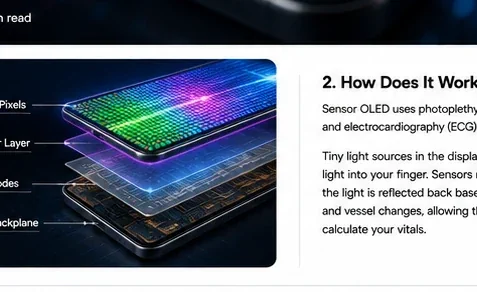
How can a display measure health signals?
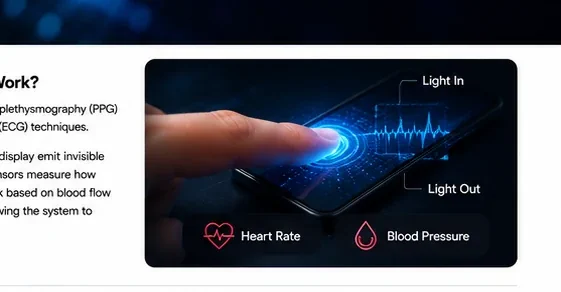
Optical biometric systems work by sending light into tissue and measuring how the reflected light changes. Blood flow affects that return signal, allowing algorithms to estimate certain cardiovascular measurements. Smartwatches already use related optical techniques on the wrist.
4 min read
Samsung coverage from PhonesGate. Published Aug 23, 2026.
Samsung Display has publicly demonstrated Sensor OLED technology capable of measuring heart rate and estimating blood pressure when a user interacts with the screen. Those are the health capabilities PhonesGate can confidently associate with the demonstrated technology today.
Why this is bigger than an in-display fingerprint sensor
Fingerprint readers solved a simple authentication problem: identify the user. Sensor OLED expands that concept into measurement. If the sensing area grows across more of the panel, the display could become a general-purpose input surface for identity and health-related interactions.
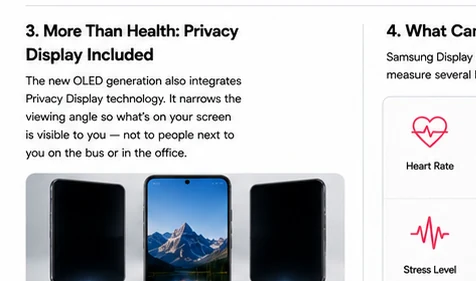
Privacy Display is part of the same broader shift
Samsung Display has also demonstrated Flex Magic Pixel, a privacy-focused display technology designed to reduce visibility from side angles while preserving a clear front view. That is separate from Sensor OLED, but together they show the same direction: future displays will do more than simply emit images.
Could your phone replace a smartwatch?
Not completely. A smartwatch has one enormous advantage: continuous contact with the body. That makes it suitable for passive heart-rate monitoring, sleep tracking, exercise metrics and long-term trend detection.
A phone-based Sensor OLED would be better suited to deliberate spot checks. The user could touch the display when they want a measurement, much like using a compact home health device.
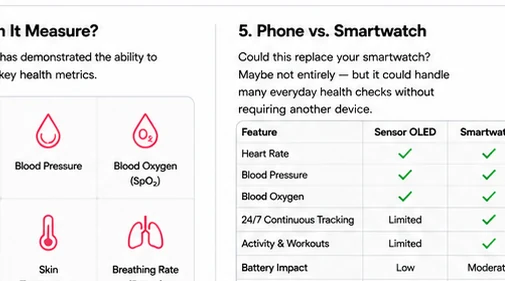
The biggest advantage: no extra hardware on the outside
Smartphone design is a constant battle for internal volume and external simplicity. Adding more sensors normally means finding additional space, cutting another opening or enlarging a camera-style module. Integrating sensing into the display stack can reduce that pressure.
There are still major limitations
Demonstration hardware is not the same as a finished medical feature. Accuracy must be validated across different skin conditions, finger placement, ambient lighting and usage scenarios. Pressure-related measurements also require careful calibration and regulatory scrutiny if manufacturers want to market them as health tools rather than general wellness indicators.
What is confirmed and what is still future-facing?
- Confirmed in Samsung Display demonstrations: integrated Sensor OLED technology using in-panel photodiodes.
- Demonstrated health functions: heart-rate measurement and blood-pressure estimation.
- Also demonstrated by Samsung Display: privacy-focused display technology using Flex Magic Pixel.
- Not yet confirmed as broad retail functionality: medical-grade monitoring across future Samsung smartphones.
PhonesGate take
The next OLED revolution may be about sensing, not picture quality. Resolution, refresh rate and peak brightness are mature enough that yearly changes increasingly feel incremental. Turning the panel into an intelligent biometric surface creates a completely different kind of upgrade.
Sensor OLED will not make smartwatches obsolete, and it should not be treated as a medical breakthrough before the technology reaches validated consumer products. But the direction is clear: the smartphone display is evolving from something you look at into something that can actively understand how you interact with it.