

For years, smartphone makers competed over one number that was never printed on the box: bezel thickness. The black border around the display shrank from thick bars to a few millimeters, then to barely more than a millimeter on the best flagships. And then progress largely stopped.
At IFA 2026, TECNO decided to push the idea one step further. Its new Bezelless concept phone removes the visible black border around the display entirely when viewed head-on. The screen appears to run straight into the metal frame with no obvious inactive strip between them.

The effect is real enough that The Verge handled an early prototype before the public IFA showing and reported that there is effectively no visible black bezel around the 6.78-inch OLED panel when looking at the phone straight on. What remains is the physical metal frame itself.
Key takeaway
TECNO’s Bezelless concept phone removes the visible black border around a 6.78-inch 144Hz OLED by hiding the inactive display edge under the frame. The result looks futuristic, but a raised metal ridge shows why true all-screen phones still have engineering trade-offs.
That distinction is important. TECNO has not eliminated the frame around the phone, nor has it invented an OLED panel with literally no inactive edge. Instead, it has changed how the screen is assembled so the inactive portion is hidden underneath the frame. The result is a genuine visual trick created through hardware engineering rather than software or curved-glass illusion.
What “0mm bezel” actually means
On a normal smartphone display, the active pixels end before the physical edge of the panel. A narrow inactive area remains around the OLED, and manufacturers usually cover that area with black masking. That is the dark border people casually call the bezel.
9 min read
PhonesGate coverage from PhonesGate. Published Sep 6, 2026.
TECNO’s concept still has an inactive edge on the OLED panel. The difference is that you cannot normally see it. The company extends the lower glass layer and the OLED assembly underneath the metal frame, while the top cover glass reaches outward to meet the frame edge.
When viewed from the front, there is no black strip between the active display and the chassis. The screen appears to stop exactly where the metal begins.
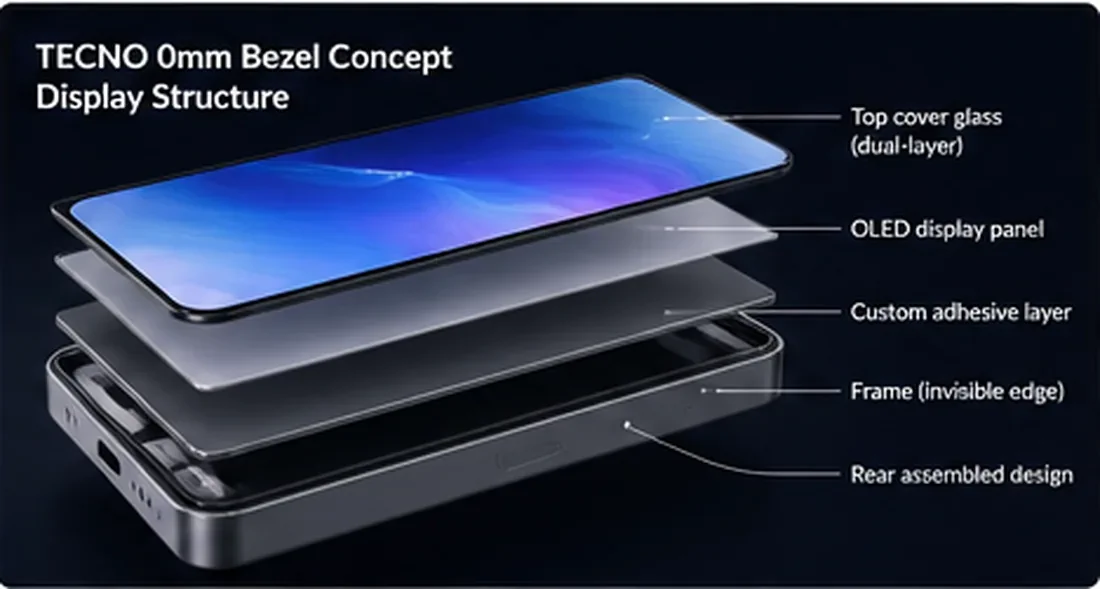
This is why “0mm visible bezel” is a more accurate description than saying the entire edge of the phone has disappeared. The concept eliminates the visible black display border, not the mechanical frame required to hold and protect the device.
TECNO had to build the phone backwards
The most interesting part of the concept is not what users see; it is what had to change behind the glass.
The Verge reports that TECNO uses a dual-layer cover-glass structure. The top glass reaches toward the edge of the frame, while the lower glass layer and OLED panel continue underneath it. Because of that geometry, TECNO could not install the display using the same front-loading approach found in most smartphones.
Instead, the display is mounted from the rear of the chassis. A custom adhesive system secures the front assembly around the frame and lower glass. In practical terms, TECNO inverted part of the normal assembly process to hide the inactive OLED edge where the user cannot see it.
That is what makes the concept more interesting than another marketing claim about “ultra-thin bezels.” The zero-border look is tied to a different mechanical architecture.
The display itself is flagship-grade enough to prove the point
The demo unit uses a 6.78-inch 1.5K OLED display with a 144Hz refresh rate. Those specifications are not the main purpose of the concept, but they matter because TECNO is demonstrating the technique on a modern high-refresh OLED rather than a low-resolution engineering panel.
The panel fills the front aggressively, while a centered punch-hole selfie camera remains visible. That hole is arguably the biggest visual reminder that “all screen” still has another problem to solve. Removing the black border makes the front look cleaner, but the camera opening remains in the display area.
TECNO could theoretically pair this bezel approach with an under-display selfie camera in a future device, but the IFA prototype does not do that. The working concept uses a conventional 32MP front camera.
The raised metal frame is the catch
Removing the visible black bezel creates a new ergonomic compromise. The metal frame sits slightly above the plane of the display.
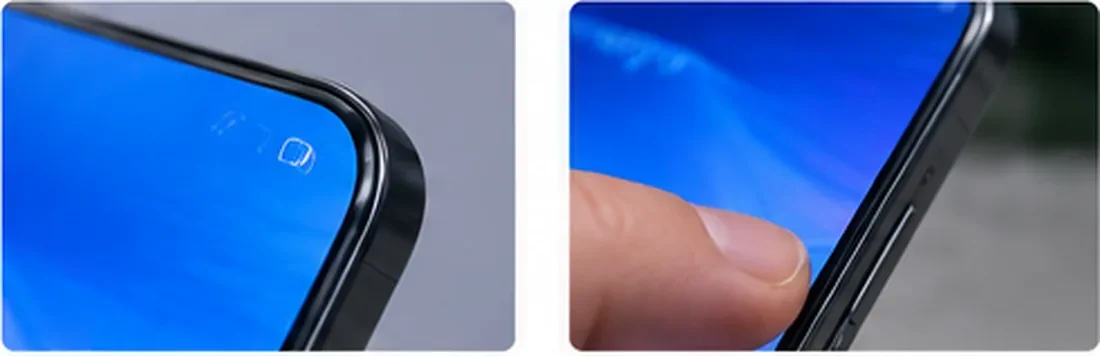
That is useful for protecting the glass, but it can interfere with modern gesture navigation. The Verge’s hands-on report notes that the ridge can catch a finger during edge gestures or upward swipes. Separate IFA reporting described the same raised-frame issue during navigation.
This is exactly the kind of problem concept hardware is supposed to expose. The phone proves that the black border can be hidden, but it also shows that a good smartphone display is not judged only by how much of the front is occupied by pixels.
A production device would need to balance four competing goals: an edge-to-edge visual effect, drop protection, comfortable gesture navigation and structural strength. Making one of those better can make another harder.
Does removing one millimeter of bezel actually improve anything?
This is the uncomfortable question for the entire project.
Modern flagship phones already have extremely thin borders. If you put the TECNO concept next to a current Galaxy S26-series phone, the difference exists, but it is not remotely as dramatic as the jump from smartphones of ten years ago to today.
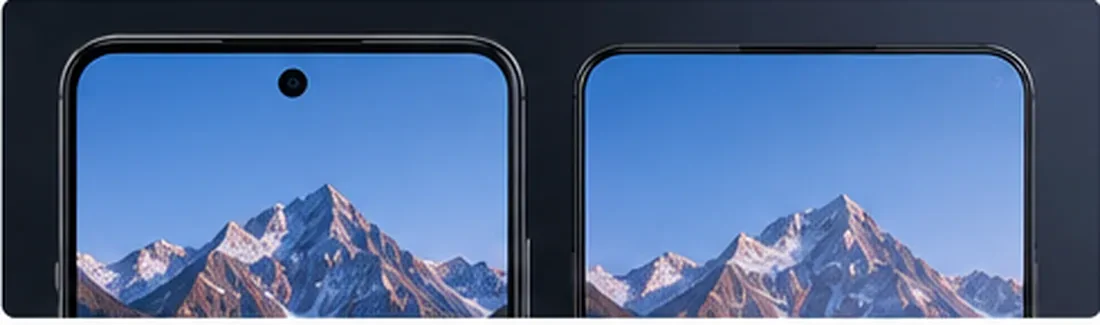
The benefit is mostly aesthetic. Photos, videos and the Android interface reach visually closer to the edge. Manufacturers can potentially fit a fractionally larger screen into the same body or reduce the body size while preserving the display area.
But the concept does not suddenly create more usable software space, eliminate letterboxing in video or change the way apps are laid out. It is an industrial-design improvement, not a new interaction model.
That is not a criticism. Smartphone design has reached a point where small engineering improvements are often all that remain. The question is whether consumers care enough about the final millimeter for manufacturers to accept the added assembly complexity.
The demo hardware is surprisingly normal
TECNO did not build the prototype around an exotic flagship platform. The IFA concept shown to press uses a MediaTek Dimensity 7400e, 8GB of RAM, 256GB of storage and a 6,000mAh battery.
The rear camera system includes a 50MP main camera and an 8MP ultra-wide. Some early images make the rear module look like it contains three cameras, but the third circular element is not another imaging sensor.
Those specifications reinforce the point: this is a display-engineering demonstrator, not a disguised flagship awaiting launch. TECNO is showing that the bezel technique can work inside something resembling a normal smartphone.
Why the prototype may never go on sale
TECNO has a history of using major trade shows to demonstrate experimental phones and materials. Some become future product ideas; others remain engineering showcases. The Bezelless device is explicitly a concept phone, and there is no announced retail launch date.
The Verge’s report goes further, describing it as a concept that is not expected to go on sale in its current form. That means PhonesGate would not treat the demo specifications as the specifications of a future commercial TECNO model.
Before mass production, the company would need to answer questions about manufacturing yield, repairability, durability, adhesive aging and the raised-frame gesture issue. A display that extends underneath the frame may also make screen replacement more complicated than on a conventional front-mounted assembly.
Those are not reasons the technology cannot ship. They are reasons a visually simple idea can take years to become boring enough for mass production.
Apple makes this concept more interesting
TECNO’s prototype arrives at an unusually relevant moment. Apple has been repeatedly linked with ambitions for a more completely edge-to-edge iPhone around the 20th anniversary of the device. That does not mean Apple will copy TECNO’s exact mechanical solution, and there is no evidence that the two companies are using the same design.
What TECNO has demonstrated is more basic and more useful: a truly invisible black OLED border is technically possible in a functional smartphone.
If Apple, Samsung, Xiaomi or another major manufacturer wants the same visual result, the challenge is no longer proving the idea can exist. The challenge is making it robust, manufacturable and comfortable enough for hundreds of millions of everyday gestures.
The real future may be invisible engineering
There is an irony in TECNO’s 0mm-bezel phone. The most interesting engineering is specifically designed so the user never sees it.
The dual-layer glass, hidden inactive panel edge, rear assembly and custom adhesive all exist to remove a strip of black material that most users had already stopped thinking about. That is what mature hardware categories look like: engineers spend enormous effort eliminating increasingly tiny imperfections.
It also changes what smartphone differentiation may look like over the next few years. Processors are fast enough for most users. OLED panels are already excellent. Cameras keep improving, but physical design is becoming harder to distinguish from one flagship to another.
A phone whose entire front appears to be active display is one of the few remaining visual milestones manufacturers can still chase.
PhonesGate take
TECNO has not killed the smartphone frame. It has done something more precise: it has shown that the visible OLED bezel can effectively disappear.
That sounds like semantics, but the distinction explains both why the concept is impressive and why it is not finished. The phone still needs a physical edge. That edge is currently raised enough to interfere slightly with gestures. And the punch-hole selfie camera still interrupts the all-screen illusion.
Yet the prototype works. It uses a real 6.78-inch 144Hz OLED, runs Android software and can be handled like a normal smartphone. The engineering behind the illusion — hiding the inactive display edge under the frame and assembling the screen from the rear — is more interesting than the marketing phrase “0mm bezel.”
Will this exact TECNO phone reach stores? Probably not. But the concept makes one thing difficult to dismiss: the final visible black border around smartphone displays is no longer an unavoidable limitation. It is now an engineering choice — and eventually, one manufacturer is likely to decide it is worth removing for good.
Sources
Image note: visuals used in this article are original PhonesGate editorial illustrations inspired by the TECNO concept and published hands-on reporting. They are not official TECNO press photography or PhonesGate hands-on photographs.