

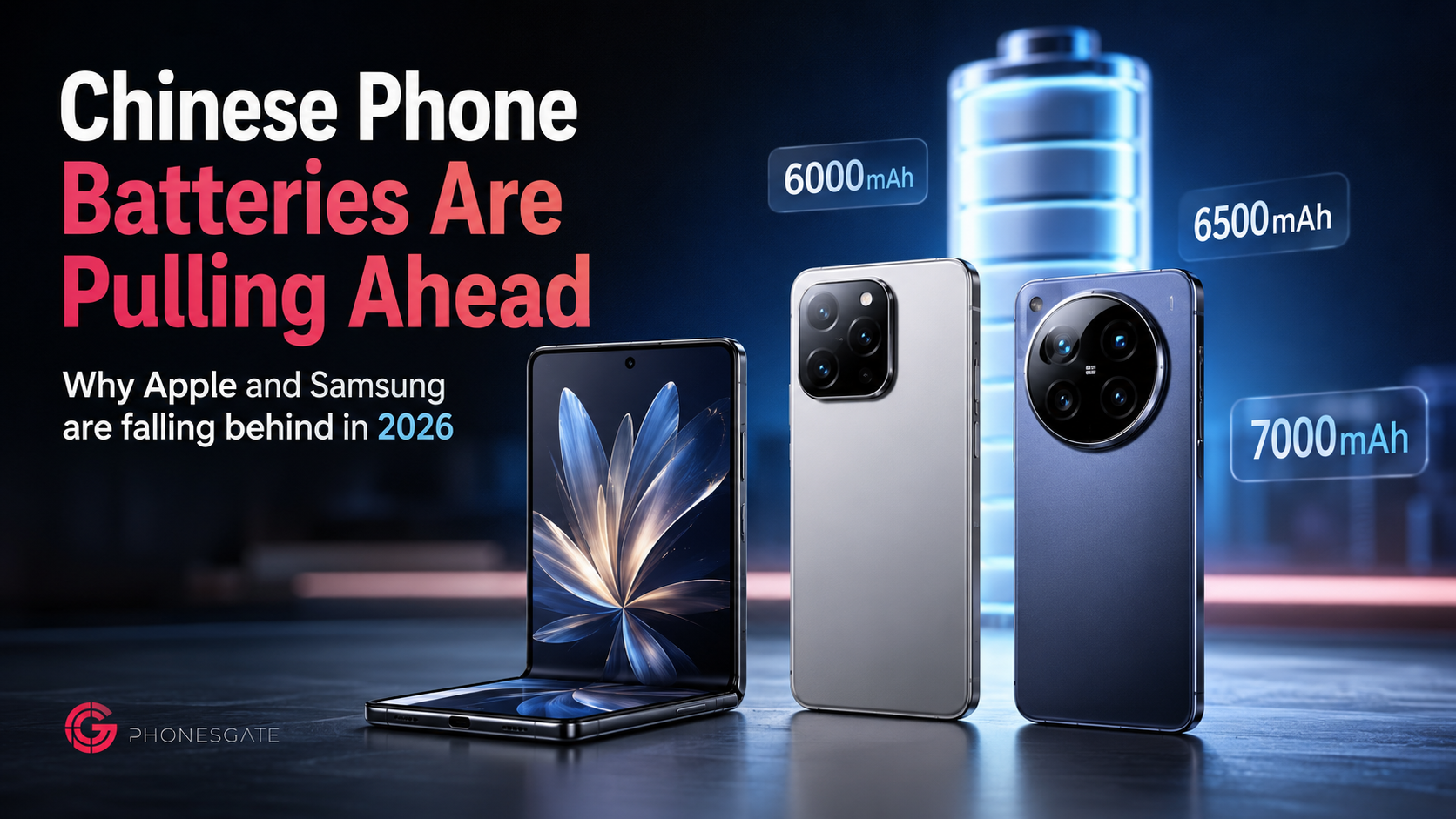
Chinese smartphone brands are pulling ahead of Apple and Samsung in one very visible specification: battery capacity. In 2026, premium phones from OnePlus, realme, HONOR, vivo, Xiaomi and OPPO are shipping with batteries ranging from 6,000mAh to 7,300mAh, often alongside 80W, 100W or 120W wired charging. Samsung’s Galaxy S26 Ultra remains at 5,000mAh, while Apple does not publish an official milliamp-hour figure for the iPhone 17 Pro Max and instead advertises up to 37 hours of video playback.
That does not automatically mean every Chinese flagship lasts longer in every test. Battery life depends on display efficiency, processor behaviour, radio conditions, software tuning and the battery’s actual energy in watt-hours—not only its headline mAh figure. But the hardware trend is undeniable: Chinese manufacturers are fitting substantially more stored energy into phones that are not necessarily thicker than their Western or Korean rivals.
This PhonesGate analysis explains how silicon-carbon batteries changed the race, which 2026 phones demonstrate the advantage most clearly, why Apple and Samsung are moving more cautiously, and what buyers should check before choosing a phone based on battery specifications.
Key takeaway
Chinese smartphone brands are pushing flagship batteries beyond 6,000mAh and even 7,000mAh. PhonesGate explains how silicon-carbon technology is changing the race with Apple and Samsung.
Quick answer
Chinese brands are moving faster because they have adopted silicon-carbon battery chemistry, higher-density cell packaging and aggressive fast-charging systems across a wider range of products. That allows devices such as the OnePlus 15 to offer 7,300mAh, the realme GT 8 Pro to reach 7,000mAh, the HONOR Magic V6 to fit 6,660mAh into an 8.75mm foldable body, and the vivo X300 Ultra to combine 6,600mAh with 100W charging.
Samsung and Apple still deliver competitive real-world endurance through efficient processors, software optimisation and conservative thermal management. However, they are currently behind in raw capacity, charging power and the speed at which next-generation battery chemistry is being commercialised.
12 min read
Apple coverage from PhonesGate. Published Jul 29, 2026.
The 2026 battery comparison
Phone Official battery claim Official charging claim Why it matters OnePlus 15 7,300mAh Silicon NanoStack 120W wired, 50W wireless One of the largest batteries in a globally marketed flagship realme GT 8 Pro 7,000mAh Titan Battery 120W wired, 50W wireless High capacity without abandoning flagship performance or wireless charging HONOR Magic V6 6,660mAh silicon-carbon Up to 80W wired, 66W wireless Exceptional capacity for an 8.75mm, 219g book-style foldable vivo X300 Ultra 6,600mAh 100W wired, 40W wireless A camera flagship that still prioritises battery size Xiaomi 17 Ultra 6,000mAh global model 90W wired, 50W wireless Large battery plus an explicit 1,600-cycle durability claim OPPO Find N6 6,000mAh silicon-carbon 80W wired, 50W wireless A 6,000mAh battery inside an approximately 8.93mm foldable Samsung Galaxy S26 Ultra 5,000mAh typical Up to 75% in around 30 minutes Strong efficiency, but limited growth in raw capacity Apple iPhone 17 Pro Max Apple does not publish mAh Up to 50% in 20 minutes; 25W MagSafe/Qi2 Excellent claimed endurance despite a more conservative charging strategy
Manufacturer endurance tests are not directly comparable because test conditions differ. Charging power can also vary by region, charger, temperature and battery level.
The biggest proof: OnePlus and realme have crossed 7,000mAh
The clearest sign of the new battery era is that 7,000mAh is no longer restricted to rugged phones or unusually thick gaming devices. OnePlus officially describes the OnePlus 15 as its first global flagship with more than 7,000mAh. Its 7,300mAh Silicon NanoStack battery is paired with 120W SUPERVOOC and 50W AIRVOOC charging.
realme follows the same strategy with the GT 8 Pro. Its dual-cell Titan Battery is rated at a typical equivalent capacity of 7,000mAh and supports 120W wired and 50W wireless charging. That is the combination that would have seemed unrealistic only a few product generations ago: flagship processor, premium display, advanced cameras, wireless charging and a battery capacity associated with much bulkier devices.
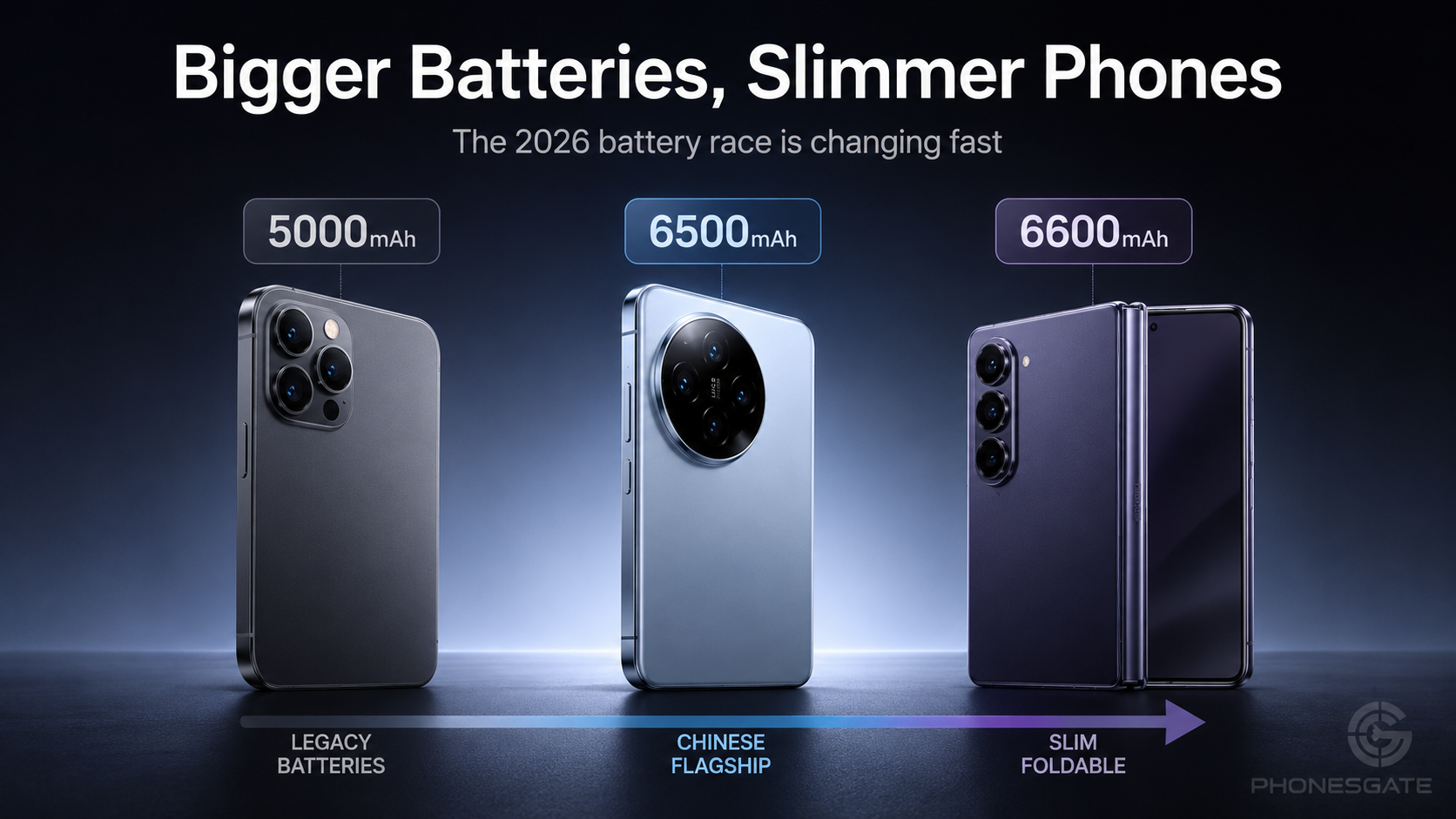
This matters because it changes buyer expectations. A 5,000mAh battery used to be the obvious flagship standard. In 2026, it increasingly looks like the baseline rather than the ceiling.
How silicon-carbon batteries fit more energy into less space
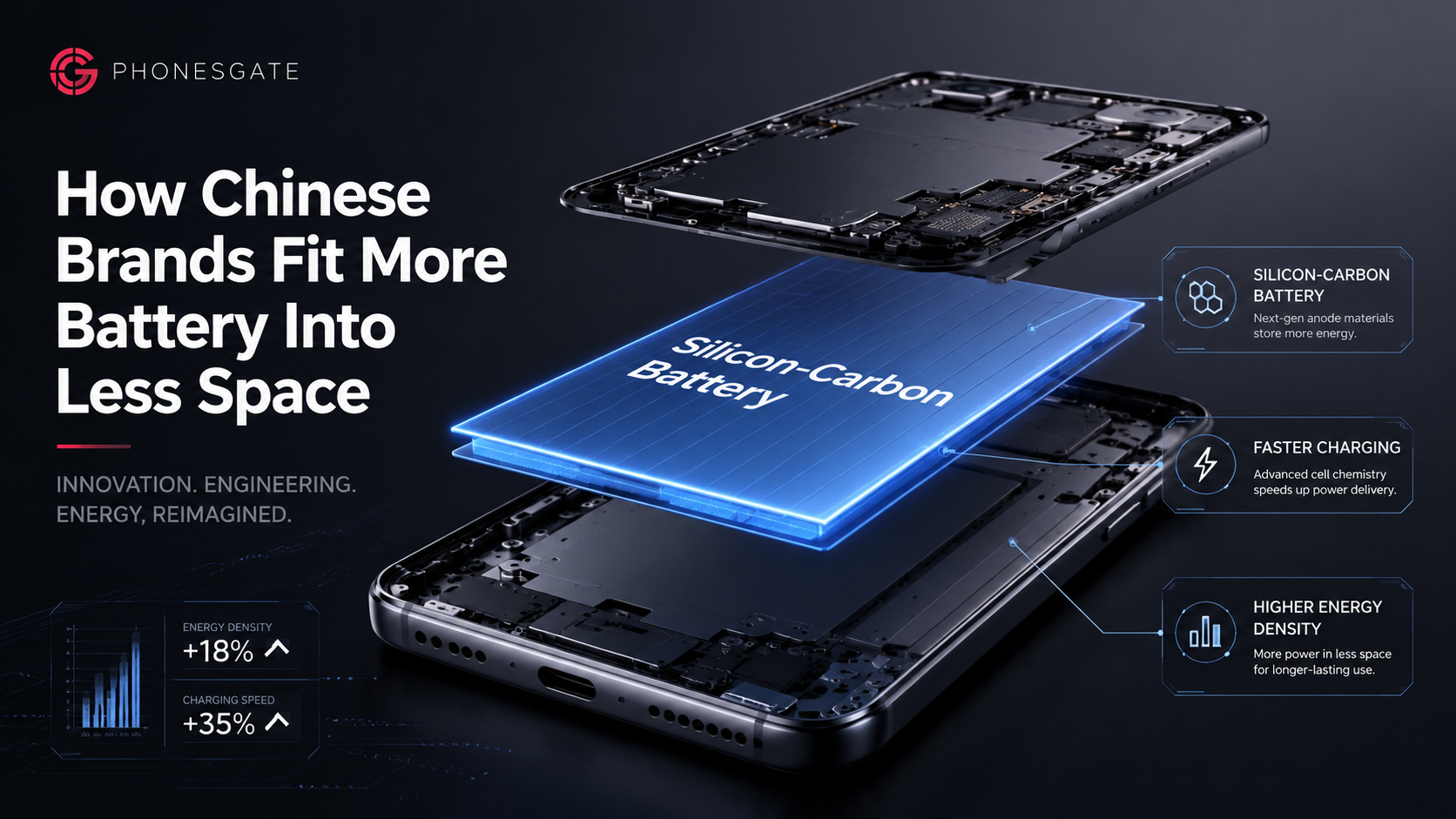
Most conventional lithium-ion phone batteries use graphite-dominant anodes. Silicon can store substantially more lithium than graphite by mass, but it also expands during charging and can degrade quickly when poorly controlled. Silicon-carbon designs attempt to capture silicon’s higher capacity while managing its expansion through composite materials, binders, cell engineering and battery-management software.
The commercial result is higher energy density. HONOR says the Magic V6 uses roughly 25% silicon content and reaches energy density of up to 921Wh/L. That helps explain how the company can place a 6,660mAh battery inside an inward-folding phone that measures 8.75mm when closed and weighs around 219g in its lightest configuration.
OPPO says the Find N6 uses a 15% silicon-content battery. The phone carries 6,000mAh while maintaining an approximately 8.93mm folded profile. These are not small engineering demonstrations; they are mainstream premium devices showing that battery chemistry can change product design.
Why energy density matters more than battery capacity alone
Capacity tells you how much electric charge a cell can deliver, but it does not fully describe stored energy. The more complete measurement is watt-hours, calculated from capacity and voltage. Two batteries with the same mAh can hold different amounts of energy if their operating voltages differ.
That is why the visual comparison between 7,000mAh and 5,000mAh is useful but incomplete. The real engineering achievement is fitting more watt-hours into a limited physical volume while controlling heat, swelling, charging speed and long-term degradation.
Chinese brands are competing on charging as aggressively as capacity
A large battery is more useful when it can also be refilled quickly. Chinese manufacturers have spent years building proprietary fast-charging ecosystems, and the 2026 generation extends that advantage.
- OnePlus 15: 120W wired and 50W wireless charging.
- realme GT 8 Pro: 120W wired and 50W wireless charging.
- vivo X300 Ultra: 100W wired and 40W wireless charging.
- Xiaomi 17 Ultra: 90W wired and 50W wireless charging.
- OPPO Find N6: 80W wired and 50W wireless charging.
- HONOR Magic V6: up to 80W wired and 66W wireless charging with supported accessories.
Apple says the iPhone 17 Pro Max can reach 50% in 20 minutes with a suitable high-wattage USB-C adapter. Samsung says the Galaxy S26 Ultra can reach up to 75% in around 30 minutes. Both are meaningful improvements, but they are still more conservative than the peak charging systems used by many Chinese competitors.
The practical difference is not always as dramatic as the wattage number suggests. Charging slows as the battery fills, temperature affects performance, and different brands calculate peak power differently. Still, higher charging headroom gives Chinese brands more flexibility to deliver useful short charging sessions.
Why Apple and Samsung are moving more cautiously
Apple and Samsung are not incapable of installing larger batteries. Their decisions reflect a different balance of priorities and risk.
1. Global scale increases the cost of failure
Apple and Samsung ship enormous volumes across many regulatory markets, carriers and climates. A battery design must survive years of real-world use, transport, repair, thermal stress and manufacturing variation. More conservative chemistry and charging policies reduce risk when a single product is produced at massive scale.
2. They optimise the complete system, not only the cell
Apple’s iPhone 17 Pro Max claims up to 37 hours of video playback, which is higher than several competitors’ official video claims despite Apple not competing publicly on mAh. Samsung’s Galaxy S26 Ultra claims up to 31 hours of video playback with a 5,000mAh battery. Efficient processors, display management and software can narrow the real-world gap created by smaller cells.
3. Internal space is allocated differently
Smartphones compete for internal volume. Camera modules, cooling systems, antennas, styluses, haptics, speakers and structural reinforcement all take space. Samsung’s Ultra design includes an integrated S Pen and a complex camera system. Apple prioritises camera hardware, Face ID components, MagSafe magnets and its own structural goals.
4. Charging longevity and thermal control remain strategic priorities
Very fast charging can be safe when supported by dual-cell layouts, multiple temperature sensors and controlled charging curves. However, Apple and Samsung historically prefer lower peak power and more conservative thermal behaviour. Their approach may reduce headline appeal but can simplify charger compatibility and long-term validation.
Why the Chinese market rewards faster battery innovation
Chinese smartphone competition is unusually intense. Brands such as Xiaomi, OPPO, vivo, HONOR, OnePlus and realme frequently launch devices with similar processors and displays. Battery capacity and charging speed become clear ways to stand out when many other specifications look alike.
There is also a strong local supply chain for cells, charging controllers, gallium-nitride adapters and high-density battery materials. Shorter feedback loops between component suppliers and device manufacturers make it easier to commercialise new designs quickly.
That competition is now influencing global products. The OnePlus 15’s 7,300mAh battery is presented as a global flagship feature, while vivo’s X300 Ultra combines a 6,600mAh battery with an internationally marketed camera system. Battery leadership is no longer limited to China-only variants, although regional differences still exist.
The global-versus-China battery problem
Buyers must still check the exact regional version. Xiaomi’s China-market Xiaomi 17 Ultra has been associated with a larger battery than the global 6,000mAh model. Other manufacturers may also alter capacity, charging accessories, software or radio hardware between regions.
Reasons can include:
- certification and transport requirements;
- physical space required for different network bands or eSIM hardware;
- charger regulations and regional packaging decisions;
- product-positioning differences between China and international markets.
Never assume a specification from a Chinese launch applies to the UK, Europe, India or North America. Check the official regional product page and the exact model number.
Does a larger battery automatically mean longer battery life?
No. A larger battery creates more potential endurance, but several factors determine how quickly that energy is consumed:
- Display size and brightness: large LTPO screens can be efficient, but high brightness and gaming still draw significant power.
- Processor efficiency: a powerful chip can deliver excellent efficiency during light tasks and still consume heavily under sustained load.
- Camera and AI workloads: computational photography, video recording and on-device models can drain a battery quickly.
- Software optimisation: background processes, app behaviour and network management strongly affect standby life.
- Mobile signal: poor reception can consume more energy than many users realise.
Manufacturer battery-life claims are useful within the same brand, but cross-brand comparisons require independent testing under identical conditions.
What about long-term battery health?
High capacity is valuable only if the battery remains healthy. Xiaomi states that the global Xiaomi 17 Ultra is designed to retain at least 80% capacity after 1,600 charging cycles under its test conditions. OnePlus also makes multi-year battery-health claims on some high-capacity products.
These claims are encouraging, but buyers should understand the limitations. Laboratory cycles do not perfectly reproduce heat, gaming, overnight charging, car dashboards, cold weather or third-party chargers. Battery management also depends on software that can change after launch.
For long-term ownership, prioritise:
- adaptive or optimised charging;
- charging-limit options such as 80% or 90%;
- accessible battery-replacement service;
- official chargers and good-quality USB-C cables;
- avoiding sustained heat whenever possible.
The best 2026 battery phones for different buyers
Buyer Best fit Reason Maximum flagship capacity OnePlus 15 7,300mAh with very fast wired and wireless charging Gaming and sustained heavy use realme GT 8 Pro 7,000mAh, 120W charging and flagship performance Foldable battery leadership HONOR Magic V6 6,660mAh in an unusually thin and light book-style foldable Camera-first flagship vivo X300 Ultra 6,600mAh without sacrificing an ambitious camera platform Battery health transparency Xiaomi 17 Ultra 1,600-cycle retention claim alongside 6,000mAh and fast charging Thin foldable with balanced charging OPPO Find N6 6,000mAh, 80W wired and 50W wireless charging Best optimised mainstream alternative iPhone 17 Pro Max Strong official endurance claim and broad service support Samsung ecosystem and repair availability Galaxy S26 Ultra Efficient 5,000mAh implementation with mature global support
PhonesGate take
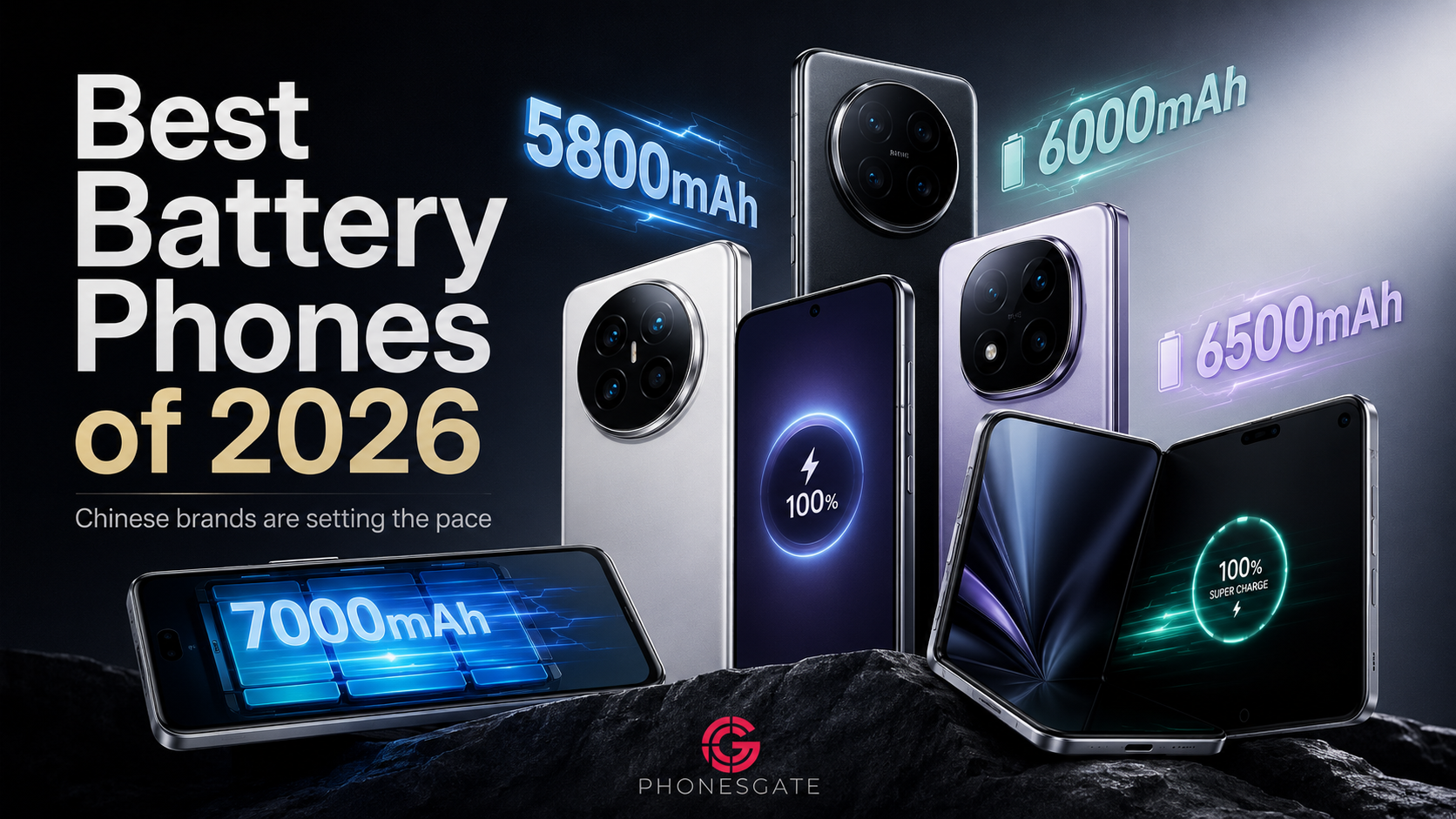
Apple and Samsung are not losing the battery-life race in every practical sense, but they are clearly losing the battery-hardware race. Chinese manufacturers are commercialising denser chemistry, larger capacities and faster charging at a pace the two market leaders have not matched.
The most impressive part is not a single 7,300mAh specification. It is the breadth of the change. A 6,000mAh cell is now appearing in thin camera flagships and book-style foldables. Capacities above 6,500mAh are becoming normal in premium devices, while 7,000mAh is entering the global flagship conversation.
Apple proves that efficiency can still deliver excellent endurance, and Samsung’s conservative design benefits from mature support and repair infrastructure. However, their competitors are no longer offering only bigger numbers. They are combining bigger batteries with slim bodies, premium cameras, wireless charging and credible longevity controls.
That pressure is good for buyers. It makes battery capacity a serious flagship battleground again instead of a specification that remained frozen near 5,000mAh for years.
Final verdict
Chinese phone batteries are pulling ahead because silicon-carbon chemistry and aggressive engineering have removed much of the old trade-off between capacity and thickness. OnePlus and realme demonstrate the new 7,000mAh flagship class. HONOR and OPPO show what the technology can do for foldables. vivo and Xiaomi prove that camera-first flagships can also carry much larger batteries.
Samsung and Apple remain competitive through efficiency, software and service quality, so buyers should not choose by mAh alone. But the direction of travel is clear: the next global battery standard is likely to be substantially higher than 5,000mAh, and Chinese brands are setting that expectation first.
Frequently asked questions
Why do Chinese phones have larger batteries?
Many Chinese manufacturers adopted silicon-carbon cells, higher-density packaging and dual-cell fast-charging systems earlier and more broadly than Apple or Samsung.
Is silicon-carbon safer than a normal lithium-ion battery?
Silicon-carbon is still part of the lithium-ion battery family. Safety depends on the complete cell design, thermal controls, manufacturing quality and charging management—not only the anode material.
Is 7,000mAh automatically better than 5,000mAh?
It provides more potential energy, but real endurance also depends on voltage, display power, processor efficiency, software and network conditions.
Which flagship has the largest battery in this comparison?
The OnePlus 15 has the largest official capacity in this comparison at 7,300mAh, followed by the realme GT 8 Pro at 7,000mAh.
Why does Apple not advertise iPhone battery capacity in mAh?
Apple usually markets tested usage metrics such as video-playback time instead of publishing the battery’s milliamp-hour capacity on its consumer specification pages.
Can very fast charging damage a battery?
Heat and high state of charge can accelerate ageing. Modern systems manage this through multiple cells, temperature sensors and variable charging curves, but long-term results still depend on usage and environment.
Sources and methodology
This article compares official manufacturer specifications available on 29 July 2026. It distinguishes raw capacity from manufacturer endurance claims and does not treat lab tests from different brands as directly comparable.
- OnePlus 15 official product page
- realme GT 8 Pro official product page
- HONOR Magic V6 official launch information
- vivo X300 Ultra official product page
- Xiaomi 17 Ultra official product page
- OPPO Find N6 official product page
- Samsung Galaxy S26 Ultra official product page
- Apple iPhone 17 Pro and Pro Max official specifications
Explore the devices on PhonesGate
- View OnePlus 15 specifications
- View realme GT 8 Pro specifications
- View HONOR Magic V6 specifications
- View vivo X300 Ultra specifications
- View Xiaomi 17 Ultra specifications
- View OPPO Find N6 specifications
- View Galaxy S26 Ultra specifications
- View iPhone 17 Pro Max specifications
- Compare smartphones side by side