

Smartphone batteries are entering one of their biggest hardware shifts in years. Capacities that once required thick, heavy phones are now appearing in increasingly slim flagships and foldables. The reason is not simply better software optimization: manufacturers are changing the chemistry inside the battery itself.
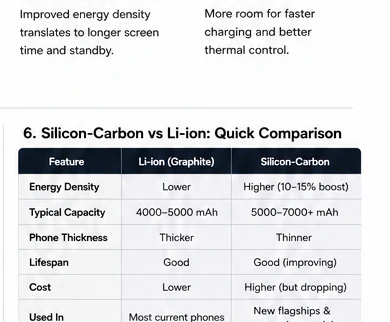
The technology driving much of this change is silicon-carbon (Si-C). It remains part of the lithium-ion family, but supplements the conventional graphite-heavy anode with silicon-containing material. The result can be substantially more energy stored inside a similar physical volume.
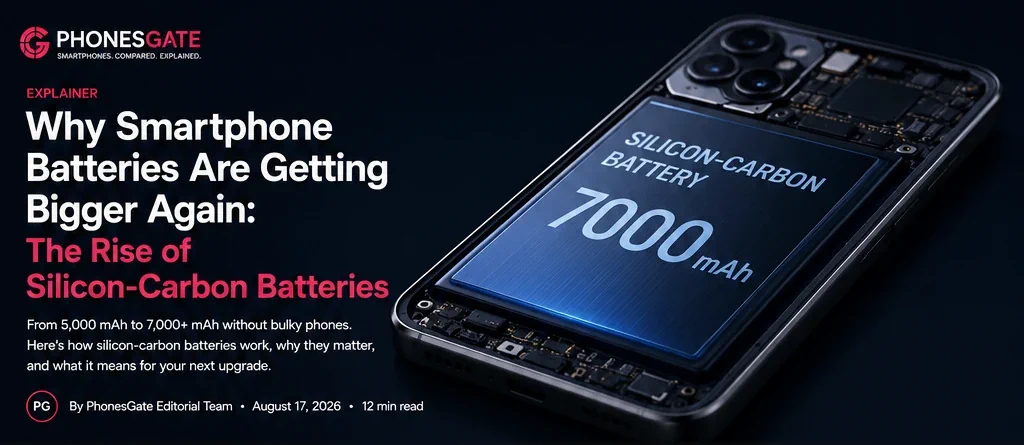
Why conventional smartphone batteries hit a wall
Traditional lithium-ion phone batteries commonly use graphite in the anode. Graphite is proven and mature, but there is a practical limit to how much energy manufacturers can pack into a given volume. For years, the simplest way to increase capacity was therefore to allocate more internal space to the battery.
Key takeaway
PhonesGate explains how silicon-carbon batteries are enabling larger smartphone capacities and thinner devices, plus the engineering trade-offs buyers should understand.
That creates an industrial-design problem. Bigger cells compete for space with camera modules, cooling systems, speakers, haptics and increasingly complex chipsets. Foldables make the problem even harder because manufacturers want thinner bodies while powering larger displays.
What silicon-carbon changes
Silicon can store far more lithium than graphite by mass, but it brings an engineering challenge: it expands significantly during charging. Silicon-carbon designs tackle this by integrating silicon into a carbon-based structure and combining it with increasingly sophisticated materials and battery-management systems.
5 min read
Xiaomi coverage from PhonesGate. Published Aug 21, 2026.
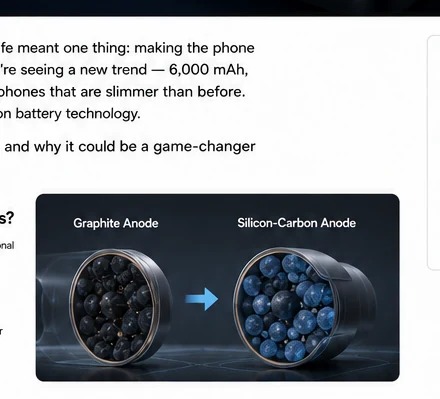
This is best understood as an evolution of lithium-ion rather than a completely separate battery category. The consumer-facing benefit is higher energy density: manufacturers can fit more capacity into similar space or preserve capacity while making a device thinner.
Why 6,000mAh and 7,000mAh phones are becoming realistic
HONOR has been one of the most aggressive early adopters. Its Magic V5 uses a silicon-carbon battery while maintaining an unusually thin foldable chassis. The earlier Magic V3 combined a 5,150mAh battery with a body measuring just 9.2mm when folded.
By 2026 the ceiling has moved higher. Xiaomi's 17T Pro has been announced with a 7,000mAh silicon-carbon battery for international markets. OnePlus, OPPO, vivo, realme and Motorola have also expanded silicon-rich battery technology across different product tiers.
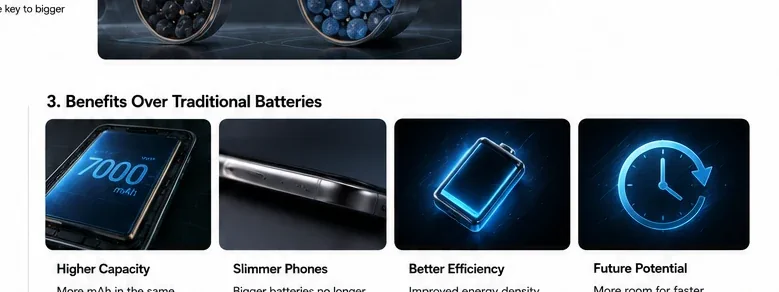
The real advantage is not just a bigger mAh number
Capacity should never be evaluated alone. A 7,000mAh phone is not automatically 40% better than a 5,000mAh phone. Display efficiency, modem behavior, chipset consumption, thermals, background processes and software optimization all influence endurance.
The important change is additional design headroom. Engineers can spend it on battery life, thinner bodies, larger camera hardware or better cooling. That is especially valuable for foldables, where every fraction of a millimeter matters.
Which brands are pushing the technology?
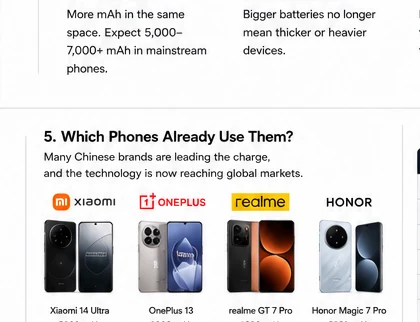
HONOR was an early high-profile adopter and has continued raising silicon content across generations. OnePlus has made high-density battery technology central to recent flagship design, while Xiaomi, OPPO, vivo, realme and Motorola have broadened adoption.
Are silicon-carbon batteries automatically better?
Not in every respect. Increasing silicon content makes cell engineering more difficult because silicon changes volume during charge and discharge. Manufacturers must control that expansion, protect internal interfaces and prevent accelerated degradation.
Long-term battery health therefore matters as much as headline capacity. Buyers should judge individual devices by measured endurance, battery-health guarantees and independent long-term testing rather than chemistry alone.
Does silicon-carbon mean faster charging?
Not necessarily. Chemistry, capacity and charging power are related but separate specifications. Charging speed still depends on cell architecture, voltage, thermal limits, charger design and the manufacturer's charging curve. Larger capacities make that balance between convenient top-ups, heat and long-term health even more important.
What this means when buying your next phone
Consumers should stop treating 5,000mAh as an automatic flagship benchmark. Two similarly sized phones can increasingly carry substantially different energy reserves. PhonesGate recommends comparing capacity, chemistry, measured real-world endurance and cycle durability together, with charging speed considered after those fundamentals.
The next smartphone battleground may be battery density
For much of the last decade, marketing revolved around cameras, refresh rates and processor benchmarks. Silicon-carbon technology is making battery engineering interesting again. The shift could be particularly transformative for compact phones and foldables because manufacturers no longer need to choose quite as aggressively between thinness and endurance.
PhonesGate take
Silicon-carbon is not magic, but it addresses a very real smartphone design constraint. Its most important achievement is not simply producing the largest possible mAh number. It gives engineers more stored energy without demanding the same increase in physical battery volume.
That can mean a thinner foldable without terrible endurance, a bigger battery alongside flagship cameras, or simply a conventional phone that lasts longer. For buyers, that is a more meaningful hardware improvement than many annual specification upgrades. The smartphone battery race is back — but this time chemistry, rather than thickness, is driving it.