

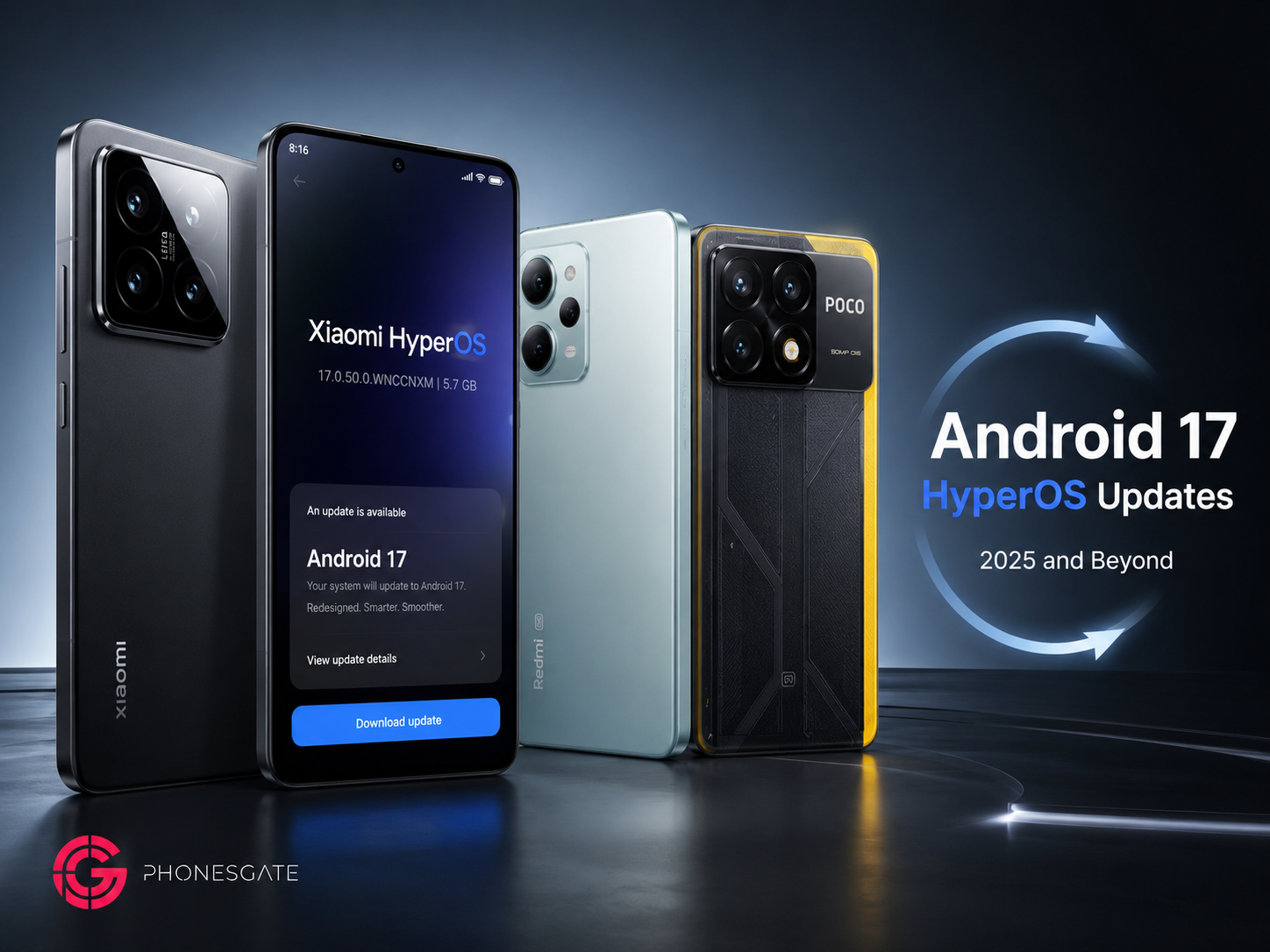
Xiaomi’s 2025 phone lineup is broadly covered for HyperOS 3, but Android 17 eligibility is much less straightforward. Xiaomi has officially listed many Xiaomi, REDMI and POCO models from 2025 on its global HyperOS 3 rollout schedule. However, only the Xiaomi 15T Pro from that generation is currently included in Xiaomi’s official Android 17 Developer Preview programme.
That distinction matters. A phone can receive HyperOS 3 without Xiaomi publicly confirming that the build is based on Android 17. Xiaomi uses the same HyperOS branding across devices with different Android foundations, hardware capabilities and feature sets. A budget REDMI model may therefore receive the new interface, animations and security changes while remaining on an older Android base than a flagship.
This PhonesGate update tracker separates official confirmations from reasonable expectations. It covers the major Xiaomi, REDMI and POCO phones launched globally in 2025, explains which updates are confirmed, and identifies the models for which Android 17 is still uncertain.
Key takeaway
Which Xiaomi, REDMI and POCO phones released in 2025 will receive Android 17 or HyperOS 3? This PhonesGate tracker separates official confirmations from expected updates.
Quick answer
Most major Xiaomi phones released globally in 2025 are confirmed for HyperOS 3. This includes the Xiaomi 15 and 15T families, REDMI Note 14 models, POCO F7 and X7 models, and several REDMI and POCO budget devices.
Xiaomi 15T Pro is the only 2025 global model currently confirmed in Xiaomi’s Android 17 Developer Preview programme. Android 17 is also expected for several other premium 2025 models, but Xiaomi has not yet published a complete global Android 17 eligibility list. PhonesGate therefore classifies each device as one of the following:
12 min read
Xiaomi coverage from PhonesGate. Published Jul 30, 2026.
- Android 17 confirmed: officially included in Xiaomi’s Android 17 testing programme.
- Android 17 expected: a strong candidate based on its launch timing, product tier and software support position, but not yet officially confirmed.
- HyperOS 3 confirmed only: listed on Xiaomi’s HyperOS 3 roadmap, with no public Android 17 commitment.
- Uncertain: support may vary by region, hardware variant or Android base.
Xiaomi 2025 update tracker
2025 model HyperOS 3 status Android 17 status PhonesGate assessment Xiaomi 15T Pro Officially listed; rollout began from late October 2025 in selected regions Official Developer Preview support Confirmed Xiaomi 15T Officially listed in the first HyperOS 3 wave Not officially listed for Android 17 Expected Xiaomi 15 Ultra Officially listed in the first HyperOS 3 wave Not officially listed for Android 17 Expected Xiaomi 15 Officially listed in the first HyperOS 3 wave Not officially listed for Android 17 Expected POCO F7 Ultra Officially listed in the first HyperOS 3 wave Not officially confirmed Expected POCO F7 Pro Officially listed in the first HyperOS 3 wave Not officially confirmed Expected POCO F7 Officially listed in the first HyperOS 3 wave Not officially confirmed Expected POCO X7 Pro Officially listed in the first HyperOS 3 wave Not officially confirmed Likely, but unconfirmed POCO X7 Officially listed in the first HyperOS 3 wave Not officially confirmed Uncertain Android base REDMI Note 14 Pro+ 5G Officially listed in the first HyperOS 3 wave Not officially confirmed Likely, but unconfirmed REDMI Note 14 Pro 5G Officially listed in the first HyperOS 3 wave Not officially confirmed Likely, but unconfirmed REDMI Note 14 Pro Officially listed in the first HyperOS 3 wave Not officially confirmed Uncertain REDMI Note 14 Officially listed in the first HyperOS 3 wave Not officially confirmed HyperOS 3 confirmed only REDMI Note 14 5G Officially listed for the December 2025–March 2026 window Not officially confirmed HyperOS 3 confirmed only REDMI Note 14S Officially listed for the December 2025–March 2026 window Not officially confirmed HyperOS 3 confirmed only REDMI 15 Officially listed for the November–December 2025 window Not officially confirmed HyperOS 3 confirmed only REDMI 15 5G Officially listed for the December 2025–March 2026 window Not officially confirmed HyperOS 3 confirmed only REDMI 15C Officially listed for the December 2025–March 2026 window Not officially confirmed HyperOS 3 confirmed only REDMI 15C 5G Officially listed for the December 2025–March 2026 window Not officially confirmed HyperOS 3 confirmed only POCO M7 Officially listed for the November–December 2025 window Not officially confirmed HyperOS 3 confirmed only POCO M7 Pro 5G Officially listed for the December 2025–March 2026 window Not officially confirmed HyperOS 3 confirmed only POCO C85 Officially listed for the December 2025–March 2026 window Not officially confirmed HyperOS 3 confirmed only
This tracker covers global models and rollout information. China-only devices, carrier variants and region-specific editions may follow different schedules.
Xiaomi 15T Pro: the only 2025 model officially confirmed for Android 17 testing
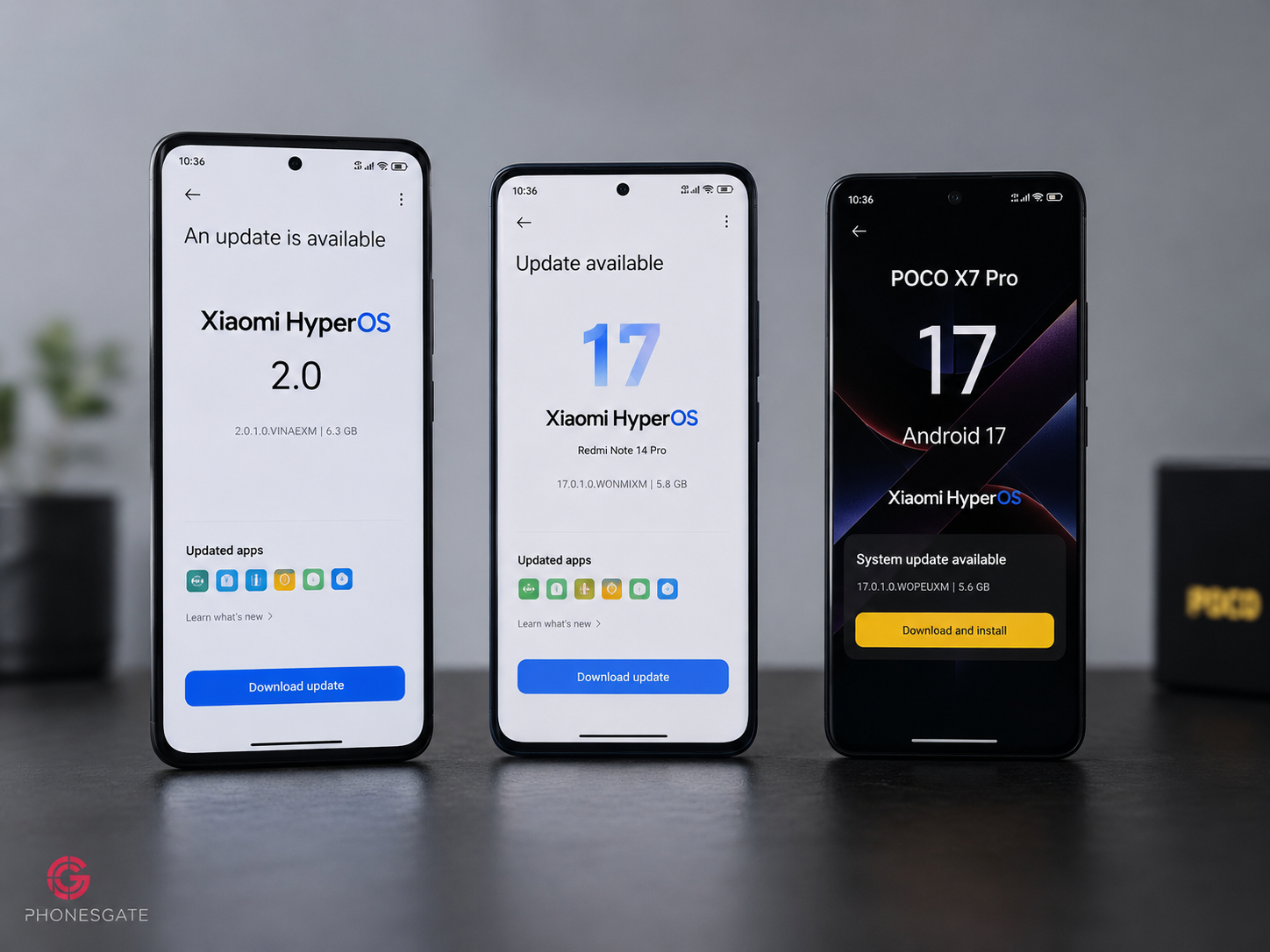
Xiaomi’s official Android 17 Developer Preview page currently lists four supported devices: Xiaomi 17, Xiaomi 17 Ultra, the Leica Leitzphone powered by Xiaomi, and Xiaomi 15T Pro. Of those, the Xiaomi 15T Pro is the only model from Xiaomi’s global 2025 phone generation.
Xiaomi provides the Android 17-compatible build OS3.0.11.0.WOSMIXM for the 15T Pro. The company also warns that the beta may be unstable, is not recommended for daily use and requires a full data wipe when flashing the ROM.
This does not mean the stable Android 17 rollout will begin immediately. Developer Preview participation confirms that Xiaomi is actively adapting the model to Android 17, but public beta and stable schedules can still differ by region and testing progress.
Which 2025 Xiaomi phones are strongest candidates for Android 17?
Until Xiaomi publishes a complete Android 17 roadmap, every model outside the Developer Preview must be labelled as expected rather than confirmed. The strongest candidates are the premium models that launched recently, use current flagship chipsets and occupy the top of Xiaomi’s support hierarchy.
Xiaomi 15 and Xiaomi 15 Ultra
Both phones are officially on Xiaomi’s first HyperOS 3 rollout list. They are premium 2025 flagships with hardware capable of supporting several major platform updates. Android 17 is therefore a reasonable expectation, but Xiaomi has not yet included either global model in its official Android 17 Developer Preview list.
Xiaomi 15T
The standard Xiaomi 15T shares the first HyperOS 3 rollout window with the 15T Pro. Its product page confirms that HyperOS 3 became available from the end of October 2025 in selected regions. Android 17 remains unconfirmed, but the phone’s launch timing and premium-midrange position make it a strong candidate.
POCO F7 Ultra, F7 Pro and F7
The entire POCO F7 family appears in the first HyperOS 3 wave. These performance-focused devices use recent processors and are positioned above POCO’s budget range. They are among the most credible Android 17 candidates, although Xiaomi has not yet published an official model-by-model Android 17 statement.
POCO X7 Pro and REDMI Note 14 Pro 5G family
These models are also high on the eligibility list, but the confidence level is lower than for the flagship ranges. Xiaomi can deliver the same HyperOS version on different Android foundations, so HyperOS 3 confirmation alone is not sufficient proof.
HyperOS 3 confirmed does not mean Android 17 confirmed
This is the most important rule in the entire update tracker. HyperOS is Xiaomi’s interface and ecosystem layer; Android is the underlying operating-system platform. The two version numbers are related, but they are not interchangeable.
A phone can receive:
- the new HyperOS interface;
- updated Xiaomi system applications;
- new animations and visual changes;
- security patches and privacy improvements;
- selected AI or connectivity features;
without necessarily moving to the same Android base as a flagship. Xiaomi explicitly notes that HyperOS features vary by model, system version, region and language. Some functions also require separate application updates.
For buyers, this means that the update screen may say “HyperOS 3” on two phones while the devices still differ in Android API level, security features and available AI tools.
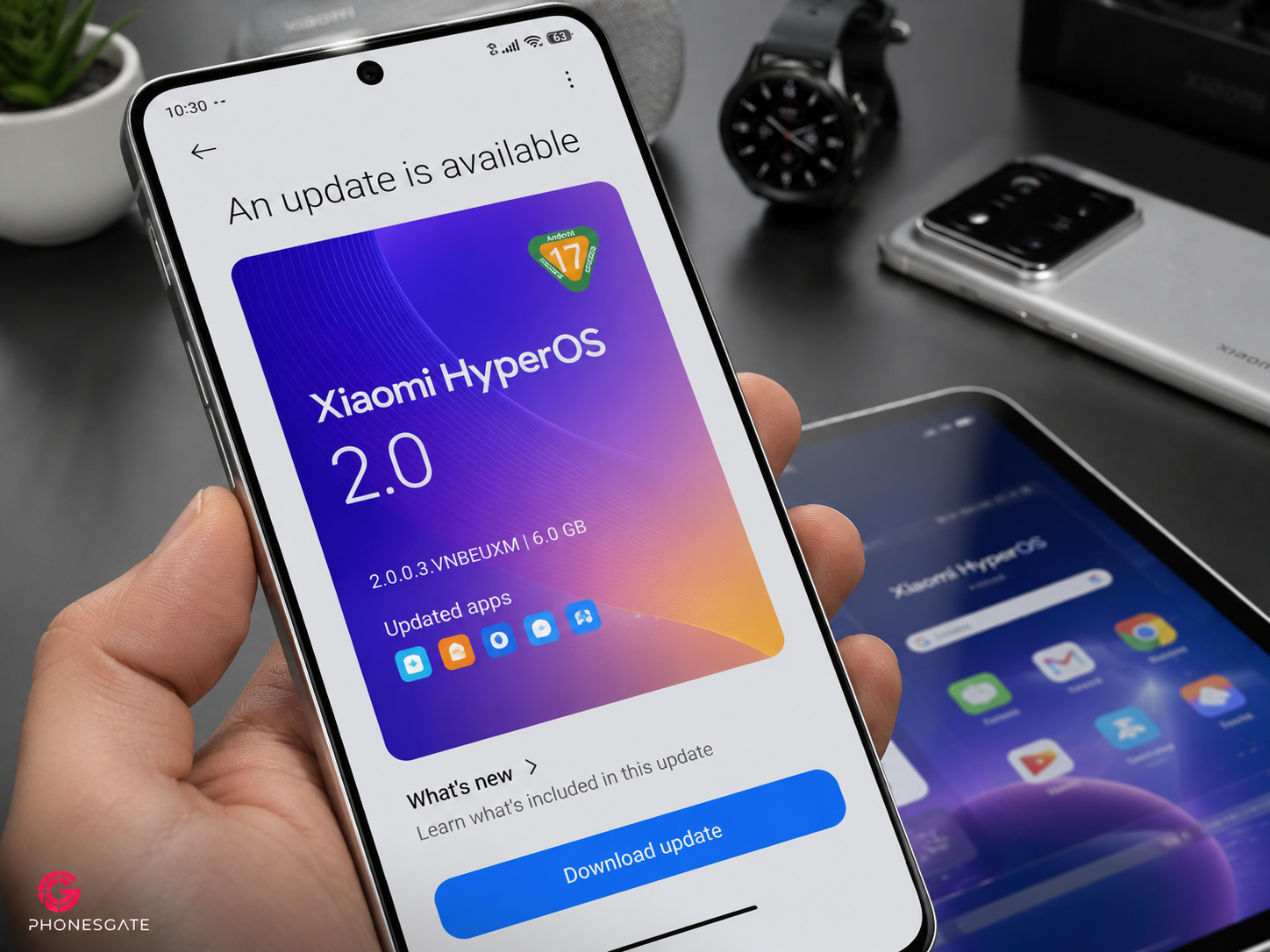
What HyperOS 3 brings to supported Xiaomi phones
Xiaomi’s official HyperOS 3 information highlights a broad set of improvements:
- Refined system animations: Xiaomi says more than 100 animations were improved.
- Xiaomi HyperIsland: a persistent information and activity area on supported devices and apps.
- Floating-window interaction: supported activities can be expanded into a floating window.
- Redesigned home screen and Gallery: availability depends on model and application version.
- AI Writing, AI Speech Recognition, AI Search and AI Interpreter: limited to supported regions, languages and devices.
- Gemini integration: including compatible connected-app and screen-sharing features.
- Touch to Share: initially highlighted for Xiaomi 15T and 15T Pro, with broader support planned.
- Cross-ecosystem connectivity: selected functions work with iPhone, iPad and Mac through Xiaomi’s interconnectivity software.
- Enhanced privacy and security: including MiTEE-based interconnectivity protection and selected quantum-resistant security mechanisms.
Not every listed phone receives every feature. HyperAI tools can depend on processor performance, RAM, local regulation, server availability and language support. Budget devices are the most likely to receive a reduced feature set.
Official HyperOS 3 rollout groups for 2025 phones
October–November 2025: first-priority models
Xiaomi placed its most important 2025 phones in the first global soft-release window:
- Xiaomi 15 Ultra
- Xiaomi 15
- Xiaomi 15T Pro
- Xiaomi 15T
- REDMI Note 14 Pro+ 5G
- REDMI Note 14 Pro 5G
- REDMI Note 14 Pro
- REDMI Note 14
- POCO F7 Ultra
- POCO F7 Pro
- POCO F7
- POCO X7 Pro
- POCO X7 Pro Iron Man Edition
- POCO X7
November–December 2025: second wave
- REDMI 15
- POCO M7
December 2025–March 2026: later rollout group
- REDMI Note 14 5G
- REDMI Note 14S
- REDMI 15 5G
- REDMI 15C 5G
- REDMI 15C
- POCO M7 Pro 5G
- POCO C85
Xiaomi describes these windows as soft-release periods. Actual availability can arrive later because updates are staged and may pause when bugs are found.
Why rollout timing differs by region
Xiaomi maintains different regional firmware branches, including global, European, Indian and other market-specific builds. Even phones with the same commercial name can therefore receive an update on different dates.
Common reasons include:
- local certification requirements;
- carrier testing;
- region-specific apps and services;
- different modem or NFC configurations;
- phased bug monitoring;
- language and AI feature availability.
A friend in another country receiving HyperOS 3 does not necessarily mean your phone is missing the update. Check the device’s exact model, firmware region and current security patch before comparing rollout status.
Budget phones need the most cautious expectations
REDMI 15, REDMI 15C, POCO M7 and POCO C85 are officially included in the HyperOS 3 roadmap, which is positive. However, Xiaomi has not confirmed Android 17 for these models.
Budget devices can face more restrictions because of:
- entry-level processors;
- lower RAM configurations;
- different launch Android versions;
- shorter product-support commitments;
- reduced compatibility with advanced AI features.
PhonesGate recommends describing these models as HyperOS 3 confirmed, not Android 17 confirmed. That wording protects readers from buying a phone based on an unsupported assumption.
How long will Xiaomi’s 2025 phones receive updates?
Xiaomi does not apply one identical support policy to every product. Its general support information says many smartphones receive system updates for around two to three years, while the company’s Android Enterprise Recommended programme promises at least one major Android update and security updates for three years from initial shipment for enrolled products.
Premium devices can receive longer support than those minimums, and Xiaomi’s Product Security Center publishes model-specific support information. However, a precise end date should only be used when Xiaomi provides it for the exact regional model.
For this reason, the safest article policy is:
- use an official end-of-support date when Xiaomi publishes one;
- use the model’s explicit launch policy when available;
- avoid converting a series-level promise into a guarantee for every regional variant;
- do not infer Android 17 from HyperOS 3 alone.
How to check the update on your Xiaomi, REDMI or POCO phone
- Open Settings.
- Select About phone.
- Tap the Xiaomi HyperOS version card.
- Choose Check for updates.
- Connect to Wi-Fi and back up important data before installing a major release.
Users should not download unofficial ROM packages from random websites. Xiaomi’s Android 17 Developer Preview requires manual installation and a data wipe, so it is intended for developers and advanced testers rather than ordinary owners.
PhonesGate take
Xiaomi’s 2025 update position is stronger than it first appears, but its communication remains too easy to misread. The official HyperOS 3 roadmap covers nearly every important 2025 global launch, from Xiaomi 15 Ultra to POCO C85. That is a positive result for owners.
The problem is Android-version transparency. Xiaomi 15T Pro has an official Android 17 Developer Preview, while the rest of the 2025 lineup is still divided between strong candidates and models with only HyperOS 3 confirmed. Many online lists erase that distinction and present expectations as guarantees.
For buyers, the best approach is to prioritise models with explicit support commitments and current flagship hardware. Xiaomi 15T Pro is the safest Android 17 choice from the 2025 generation. Xiaomi 15, Xiaomi 15 Ultra, Xiaomi 15T and the POCO F7 family are strong candidates. Budget REDMI and POCO models should be purchased based on their current software and confirmed HyperOS support—not an assumed Android 17 upgrade.
Final verdict
Most Xiaomi, REDMI and POCO phones released globally in 2025 are officially covered by HyperOS 3. The first wave included Xiaomi’s flagship and performance models, while REDMI 15, REDMI 15C, POCO M7 and related budget devices followed in later rollout groups.
Android 17 is a separate question. Xiaomi 15T Pro is officially confirmed for developer testing. Several premium models are highly likely to follow, but Xiaomi has not yet issued a complete global Android 17 eligibility list.
Until that list exists, the most accurate answer is simple: HyperOS 3 support is broad and official; Android 17 support remains selective and partly unconfirmed.
Frequently asked questions
Which 2025 Xiaomi phone is officially confirmed for Android 17?
Xiaomi 15T Pro is included in Xiaomi’s official Android 17 Developer Preview programme.
Will Xiaomi 15 and Xiaomi 15 Ultra receive Android 17?
They are strong candidates because they are premium 2025 flagships and are already listed for HyperOS 3, but Xiaomi has not yet included them in its official Android 17 Developer Preview list.
Does HyperOS 3 mean the phone runs Android 17?
No. HyperOS and Android are separate version layers. Two phones can run HyperOS 3 while using different Android bases and receiving different features.
Will POCO F7 and POCO X7 Pro receive Android 17?
Both are officially confirmed for HyperOS 3. Android 17 is expected for the higher-tier POCO models, but Xiaomi has not published a final global confirmation.
Will REDMI Note 14 phones receive HyperOS 3?
Yes. Multiple REDMI Note 14 variants appear on Xiaomi’s official global HyperOS 3 roadmap, although their rollout windows and Android bases differ.
Why has my phone not received HyperOS 3 yet?
Xiaomi distributes updates gradually. Region, model variant, carrier approval, firmware branch and temporary rollout pauses can all affect timing.
Sources and methodology
This tracker prioritises Xiaomi’s official Android 17 Developer Preview page, the official global HyperOS 3 release schedule, Xiaomi product pages and Xiaomi’s Product Security Center. “Expected” classifications are PhonesGate assessments and are clearly separated from official confirmations.
- Xiaomi Android 17 Developer Preview programme
- Xiaomi HyperOS 3 features and global release schedule
- Xiaomi 15T Pro official product page
- Xiaomi 15T official product page
- Xiaomi Product Software Support Information
- Xiaomi Android Enterprise Recommended support policy
- Xiaomi general system-update cycle guidance