

Will the EU force phone makers to bring back batteries you can swap in seconds? That is the seductive headline circulating ahead of 2027. The real change is more useful—and more complicated. European rules are pushing phones toward longer battery life, accessible spare parts and less obstructive repair, but they do not guarantee the return of the plastic, pop-off back cover.
The key dates are easy to confuse: a smartphone-specific EU ecodesign framework has applied since 20 June 2025, while the battery removability and replaceability provisions in the wider EU Batteries Regulation are scheduled to apply from 18 February 2027. They sit alongside one another, and their technical requirements and exceptions matter. This PhonesGate explainer separates the rules already in force from the 2027 milestone—and turns them into a practical checklist for buyers.
Reporting method: PhonesGate examined the published EU smartphone ecodesign regulation, the EU Batteries Regulation and European Commission guidance and consumer information. This is a source-based policy explainer, not legal advice, a repair tutorial or a hands-on assessment of any particular smartphone. Requirements may vary by product category, route to market and applicable derogations.
Key takeaway
EU smartphone repair rules already apply, and broader battery replaceability provisions arrive in February 2027. Here is what buyers should actually expect.
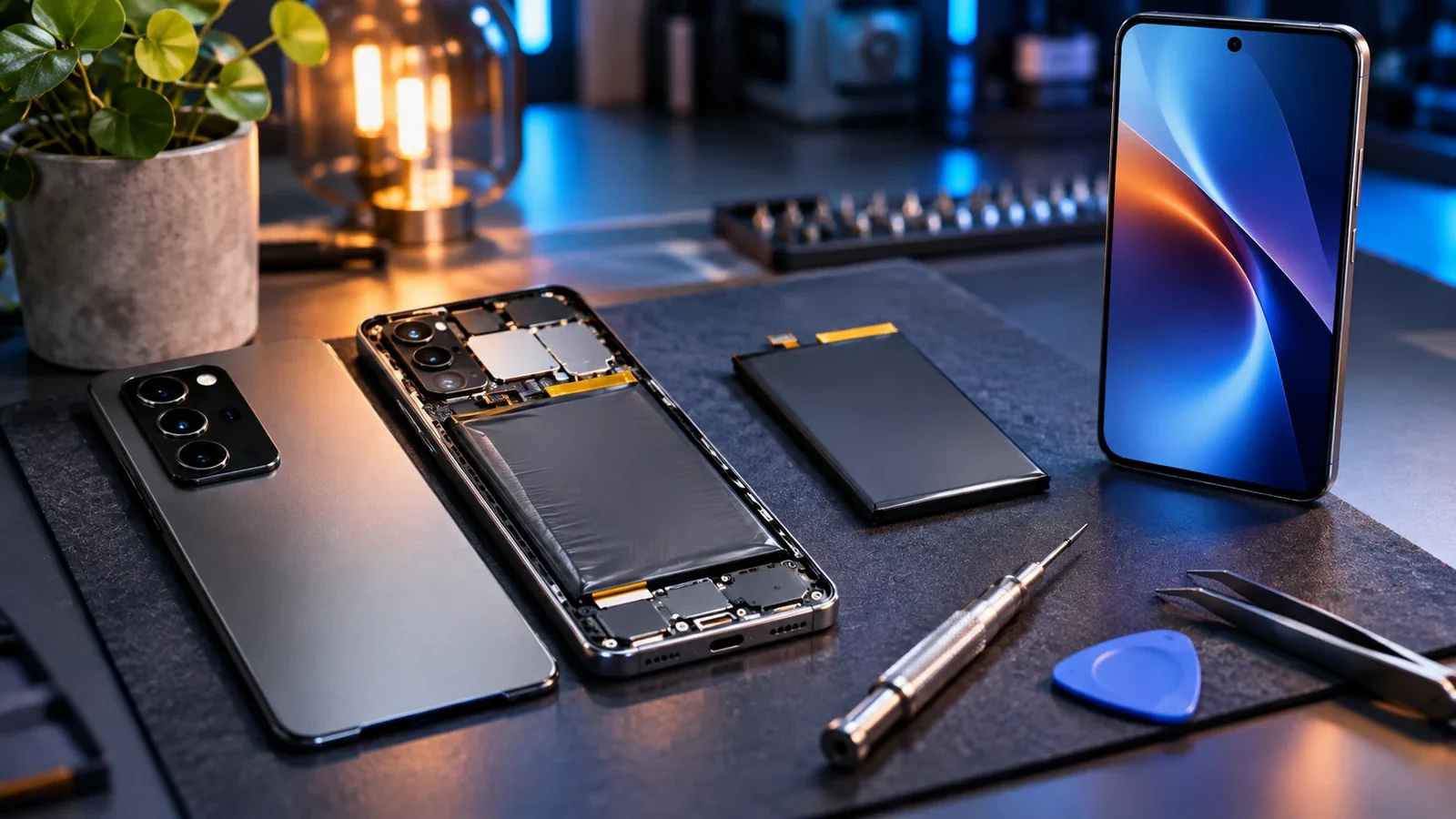
The timeline: what changed in 2025 and what happens in 2027?
20 June 2025: EU rules on ecodesign and energy labelling started applying to smartphones and certain other products placed on the EU market. They cover battery endurance, repair access, spare parts, product durability and information useful for comparing devices. The European Commission's smartphone and tablet overview explains that the battery endurance requirement is at least 800 complete charge/discharge cycles while retaining 80% of the initial capacity under the prescribed test.
18 February 2027: Article 11 of Regulation (EU) 2023/1542 becomes applicable. It sets broader expectations around the removability and replaceability of portable batteries incorporated into products, subject to its detailed conditions and derogations. The Commission's guidance on Article 11 describes this timetable.
10 min read
PhonesGate coverage from PhonesGate. Published Nov 6, 2026.
Why the distinction matters: 2027 is not the date when every phone suddenly becomes easy for an untrained consumer to open. A smartphone maker selling in the EU already has product-specific obligations; and the practical result depends on the technical replacement route, repairer access, battery durability and other requirements. The regulation does not say that every handset must have the same back-panel mechanism.
Will every smartphone get a user-removable battery?
No—not necessarily. A replaceable battery and a battery that slides out without tools are different things. The EU smartphone ecodesign rules include an end-user-accessible replacement pathway. They also allow more restrictive approaches under specified conditions, including stronger battery durability requirements and protection against dust and water. In some cases, replacement and spare-part access can primarily involve professional repairers.
Under the smartphone-specific pathway, professional-only battery spare-part supply is tied to conditions that include at least 83% capacity remaining after 500 full cycles, 80% after 1,000 full cycles and IP67 protection. These are particular regulatory thresholds, not a claim that every EU phone achieves identical real-world ageing or that IP67 automatically qualifies any design for an exemption. See the relevant provisions in the consolidated smartphone regulation.
Put simply: a sealed handset may still be compliant if its design, durability and repair arrangements satisfy the applicable rules. An easily lifted back cover is one possible solution, not a universal legal design template. A repairability claim should therefore be checked against the exact product, its documentation and the actual replacement procedure—not a viral headline.

What the EU already requires for smartphone longevity
1. Batteries that remain useful after hundreds of cycles
Capacity retention after repeated full charge cycles is a more meaningful longevity metric than a marketing phrase such as “seven-year battery.” The minimum EU ecodesign threshold for covered devices is 800 cycles with at least 80% capacity retained in the specified test. One cycle means an amount of charging and discharging equivalent to one full cycle; it is not always identical to a single day on the calendar.
Real owners experience different outcomes because temperature, charge-management software, heavy gaming, wireless charging, long storage at high state of charge and user habits vary. A laboratory requirement does not promise that a particular battery will show exactly 80% health on a specific date.
2. Batteries and other critical spare parts for years
For covered smartphones, manufacturers have obligations to make specified spare parts available for at least seven years after the model stops being placed on the EU market. Parts may include batteries, relevant back-cover assemblies, display assemblies and other components under the applicable list. Ordering rules and the eligible recipient—end user or professional repairer—depend on the part and compliance route. The Commission summarises the framework in its June 2025 announcement.
This matters when evaluating an expensive phone at its three-year mark. A battery replacement that can be ordered and fitted at a transparent, reasonable cost may extend the device's useful life more than one incremental increase in processor speed.
3. Less obstruction from software and repair procedures
The regulations address repair information and access to necessary software or firmware tools for replacement procedures. Under the broader Batteries Regulation, Article 11 also restricts software practices that obstruct replacement with compatible batteries within its scope. But none of this means that every replacement battery is automatically safe or that authentication, calibration and warranty questions disappear. Product-specific instructions and applicable safety requirements still matter.
4. Battery-health details that buyers can actually inspect
The smartphone ecodesign rules require access to certain battery-management information, including cycle count and measured state of health in the system settings or another accessible location. That gives buyers a better starting point when checking a used phone. It should not be confused with an independent medical-grade diagnostic: software estimates and battery calibration can vary.

Why this matters more now that phones have 10,000mAh batteries
2026 provides a striking demonstration of the engineering race. HONOR says its Power2 has a 10,080mAh battery in a 7.98mm chassis, while vivo describes the Y600's 10,000mAh battery as using silicon-anode technology. Those claims come from HONOR official launch and vivo product documentation; they are not cross-device test results from PhonesGate.
More stored energy is valuable, but raw mAh alone cannot predict how many days you will get. The battery's watt-hours, display, cellular reception, workload, software and charging habits all influence the experience. For example, vivo gives its Y600 a typical energy rating of 37.30Wh as well as the headline 10,000mAh figure. That watt-hour rating is useful when comparing energy stores across different cell voltages.
More capacity can also create a future serviceability question. A phone with exceptional battery life out of the box is more appealing still if its cell can be replaced after several years without an unreasonable repair cost. Readers looking for the chemistry behind the trend can explore PhonesGate's earlier analysis of silicon-carbon smartphone batteries; for an example with actual device specifications and lab-claim caveats, see the vivo Y600 battery explainer.
These are complementary stories. Battery density helps make large capacities possible; repairability and spare-part support determine whether those benefits survive years of ownership.
The new EU energy label is a buying tool, not just a green sticker
Since June 2025, the EU energy label for covered smartphones has displayed more than an efficiency grade. It also communicates battery endurance per charge, battery durability, resistance to accidental drops, repairability and protection against dust and water. A QR code connects to the EU's EPREL product database for more information. The European Commission offers a consumer guide to the smartphone energy label.
For a buyer comparing two phones with similar processors and camera systems, those indicators can reveal a meaningful difference in expected ownership cost. A slightly more expensive model with a stronger repairability grade and a documented replacement pathway may cost less to keep over four years—but the price of a replacement cell and actual servicing terms still need to be checked.
The repairability grade is not a prediction of your particular phone's failure rate. Nor does an endurance score replace testing under your own screen brightness, network conditions and apps. Treat the label as comparable standardized evidence, not an all-purpose quality verdict.
Five questions to ask before buying a phone in 2027
- Is this the EU-market version? A phone sold in Europe may differ from a similarly named China- or US-market variant. Check the precise model identifier and local product page.
- Can I obtain a replacement battery? Look for the manufacturer's ordering process, spare-part availability period, service price and any requirement to use a qualified repairer.
- Is replacement practical and safe? Ask what disassembly is involved, whether a water-resistance seal must be replaced and whether calibration or software steps are required.
- What do the durability indicators say? Look beyond nominal mAh to cycle-life information, the EU energy label and real-world testing from independent reviewers.
- How long will the phone remain usable? Consider security-update commitments, repair costs, display protection, connectivity and resale value—not only the battery.
For buyers outside the EU: EU rules govern products within their legal scope and market. They should not be assumed to create identical rights for phones sold in Albania, the UK or the US. A local retailer's warranty, availability of authorised service and exact regional model remain essential checks. Importing a phone does not automatically import every consumer protection associated with EU-market supply.
What 2027 does—and does not—mean for buyers
The best outcome is not the nostalgic return of every removable plastic battery cover. It is a world where a phone that still has a good screen, usable cameras and supported software does not become disposable because the battery has degraded. Better cell durability, obtainable parts and fair repair access all point in that direction.
But there are three important limits. First, regulations typically apply by product type and market placement rather than forcing manufacturers to retrofit every old handset. Second, exemptions and technical compliance routes are real, not loopholes a headline can ignore. Third, manufacturers' marketing language about battery life and lifespan is not a substitute for clear repair procedures and verifiable performance data.
For most shoppers, the immediate action is straightforward: compare the EU energy label, look up the battery-replacement route, and ask for a written service cost before paying premium prices. The 2027 milestone matters because it adds pressure toward replaceability—but thoughtful buying starts with the rules already in effect.
FAQ
Will every smartphone have a removable back in 2027?
No. The law focuses on removability and replaceability under detailed conditions. Different compliant repair arrangements can exist; an old-style snap-off cover is not required on every device.
Does the 800-cycle requirement mean a battery lasts only 800 days?
No. Cycles measure cumulative charging and discharging, not calendar days. The regulatory test addresses capacity retention after a number of complete cycles under defined conditions.
Does the EU rule apply to phones already sold years ago?
The obligations are tied to defined dates and products placed on the market within the rules' scope. They do not create a blanket requirement to redesign older devices already in use.
Does the law require five major Android updates?
No. EU software-support obligations are more nuanced than a guarantee of five major version upgrades. Check the vendor's specific security and OS-update policy for the exact handset.
Sources and editorial transparency
- Regulation (EU) 2023/1670 — consolidated smartphone ecodesign requirements (including 2025 amendment).
- Regulation (EU) 2023/1542 — Batteries Regulation and European Commission interpretation guidance for Article 11.
- European Commission — Smartphones and Tablets and consumer guide to the new energy label.
- HONOR Power2 launch announcement and vivo Y600 official product information for manufacturer product examples.
Editorial note: This is independent, original PhonesGate explanatory reporting researched on 5 November 2026. It contains no sponsored recommendation. All images in this draft are AI-generated, generic editorial illustrations, not manufacturer photos or evidence of a specific device's repair internals. Technical and legal interpretations should be rechecked against current EU guidance before later republication or material updates.